Architecting Authority

Technical SEO That Makes Your Website Crawlable, Indexable and Trusted.

Most content does not fail because it is bad. It fails because Google cannot crawl, index, render or understand the system around it. Groew fixes the technical foundation before more content, links or landing pages are wasted.
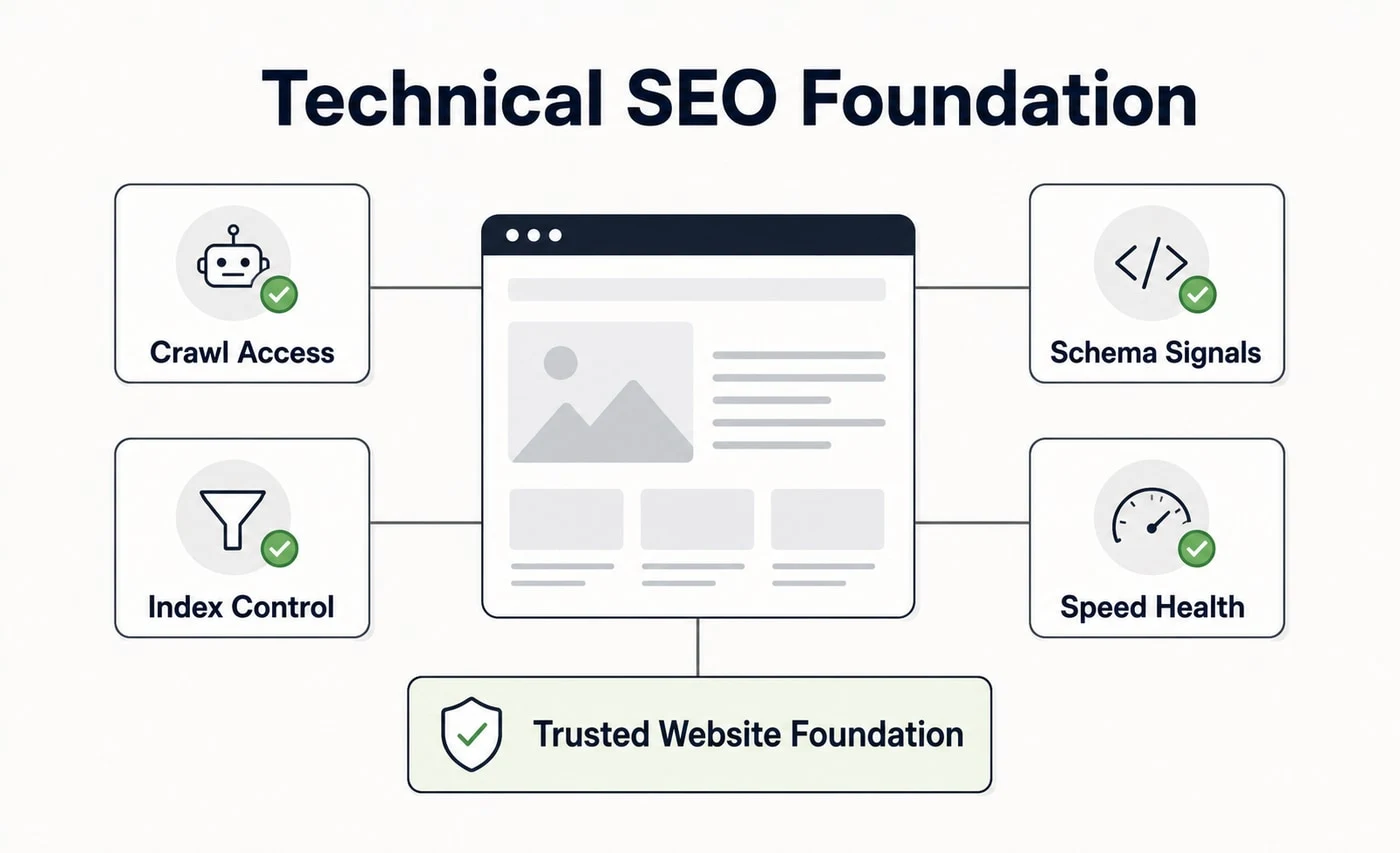
Technical Foundation Crawl Index Schema Links

A clean technical foundation helps Google and AI systems read the same structure your buyers experience on the page.

Fast Answer

Technical SEO fixes the system behind the page.

Technical SEO is the work that helps search engines crawl, index, render and understand a website correctly. For a B2B site, that means clean URL signals, correct canonicals, working redirects, accessible content, schema, fast mobile pages and a link structure that points authority toward commercial pages.

What We Audit

The technical signals that decide whether SEO can compound.

We do not treat technical SEO as a checklist. We connect every issue to search visibility, buyer path, implementation effort and risk.

Crawl Access

We check whether Google can reach the pages that matter, whether crawl rules block useful URLs, and whether important pages are buried too deep.

  • robots.txt
  • crawl depth
  • blocked paths

Indexing Control

We find pages that should be indexed, pages that should stay out of Google, and pages that are being ignored because the signals are mixed.

  • noindex
  • index coverage
  • sitemap quality

Canonical Signals

We check duplicate pages, preferred URLs, trailing slash patterns, HTTP variants and canonical tags so Google knows which page should rank.

  • canonical tags
  • duplicate URLs
  • preferred version

Redirect Paths

We review old URLs, redirect chains, broken redirects and migration paths so authority does not leak during redesigns or platform moves.

  • 301 rules
  • redirect chains
  • old URLs

Core Web Vitals

We check load speed, layout shift and interaction delay because poor mobile performance can reduce trust before the page even gets read.

  • LCP
  • CLS
  • INP

Structured Data

We review schema markup so Google and AI tools can understand the organisation, service, article, FAQ and local entity signals clearly.

  • Service schema
  • FAQ schema
  • Organization schema

JavaScript Rendering

We check whether important content, links and metadata appear in the rendered page, not only after scripts run for a user.

  • rendered HTML
  • hydration risk
  • hidden links

Internal Link Flow

We map how authority moves through the site, which pages receive support, and where valuable pages are isolated from the main system.

  • link depth
  • hub pages
  • orphan pages
Founder Risk

Good content cannot outrank a broken foundation.

A founder can pay for strong articles, service pages and links, then still lose visibility because Google sees duplicate URLs, broken redirects, blocked crawlers, slow mobile pages or missing structured data.

The expensive mistake is publishing more content before the site can support it. Technical SEO decides whether every future page has a fair chance to rank.

What You Get

Clear fixes, not a confusing audit dump.

  • Impact first priority order We show what affects revenue pages, indexing and buyer journeys first.
  • Developer ready instructions Fixes are written so a developer can act without guessing what the SEO person meant.
  • Validation after fixes We recheck the site after implementation so the same issue does not keep repeating.
Deliverables

What Groew includes in technical SEO work.

The output is built for founders, marketers and developers. Clear enough to understand. Specific enough to implement.

Technical SEO audit with severity and business impact
Search Console issue interpretation in plain English
Developer brief with exact fixes and priority order
Redirect and canonical map for risky URL changes
Schema recommendations for service, article and FAQ pages
Core Web Vitals review by mobile and desktop experience
Post fix validation so the same issue is not reported twice
Technical roadmap that supports the 90 day SEO sprint
Migration Protection

Redesigns and migrations can erase authority overnight.

Technical SEO becomes urgent when URLs change, platforms move, domains consolidate or a redesign goes live. Most traffic loss after a rebuild comes from preventable issues: missing redirects, changed internal links, duplicate canonicals, blocked staging rules or pages removed without a replacement path.

  • Before launch URL inventory, redirect map, canonical plan, sitemap plan and staging crawl.
  • During launch Crawl checks, Search Console monitoring, analytics validation and priority issue triage.
  • After launch Index review, redirect validation, ranking movement and authority recovery checks.
AI Crawl Readiness

AI search also needs clean technical signals.

AI search visibility is not only copy. It depends on accessible pages, consistent entity signals, structured data, author information, clean internal links and pages that can be retrieved without hidden client side barriers.

Technical SEO makes your site easier for Google AI Overviews, ChatGPT, Perplexity and Gemini to understand. The same foundation that helps Google crawl also helps AI tools extract clear answers.

  • Entity clarity Organization, Service, Article and FAQ schema aligned with page purpose.
  • Accessible answers Important content present in rendered HTML, not hidden behind fragile scripts.
  • Internal proof paths Commercial pages connected to guides, tools, client evidence and relevant FAQ sections.
Proof Signal

Technical foundation before compounding.

For Impresio Studio, the site started with no meaningful organic search structure. We fixed the technical foundation, mapped topical architecture and connected pages through internal links before scaling the content system. Within 90 days, the property reached 1.04 million organic impressions and 12,700 clicks from zero.

1.04M organic impressions in 90 days
12,700 organic clicks after foundation work
7.6 average position during early compounding
What We Avoid

This is not cheap maintenance work.

We do not sell a one time PDF audit with no implementation path.
We do not chase perfect speed scores while revenue pages stay unclear.
We do not install random plugins and call that technical SEO.
Alokk's perspective
Alokk, Founder at Groew
Alokk Founder and Lead Growth Architect, Groew
The technical issues that hurt founders are rarely dramatic. They are usually small signals stacked together: duplicate URLs, old redirects, buried service pages, missing schema and content that appears too late in the rendered page. When we fixed foundation and topic structure before scaling content for Impresio Studio, the site reached 1.04 million impressions in 90 days. That is why I do not separate technical SEO from Revenue Infrastructure. It protects every page that comes after it.
Questions

Common questions about technical SEO services.

Technical SEO is the work that helps search engines crawl, index, render and understand a website correctly. It includes crawl access, indexing control, canonical tags, redirects, page speed, structured data, JavaScript rendering, sitemaps, robots.txt and internal links.
Content compounds faster when the technical foundation is clean. If Google sees duplicate pages, blocked URLs, broken redirects or weak internal links, strong content may never get a fair chance to rank.
Groew creates the audit, priority order and developer ready fixes. Depending on the site stack, we either implement directly or work with your developer until the fixes are validated.
Sometimes. If traffic dropped because of redirects, canonicals, noindex tags, internal link collapse, crawl blocks or a migration issue, technical SEO can remove the blocker. If the cause is weak content or lost authority, it has to be paired with content and authority work.
Yes. AI search tools need accessible pages, structured data, clear entities, author signals and stable internal links. Technical SEO makes those signals easier to read and cite.
From Groew's Search Authority Team

How to think about technical SEO before buying more content

Technical SEO is not the most visible part of search growth, but it is often the part that decides whether the visible work can compound. The goal is simple: make the site easier for Google, AI systems and buyers to understand.

Start with crawl and index clarity

The first question is not whether the site has enough content. The first question is whether Google can find, crawl and index the pages that matter. A service page hidden four clicks deep, blocked by a crawl rule, duplicated across multiple URL versions or excluded by a noindex tag cannot support revenue. This is why technical SEO starts with crawl and index clarity. It removes uncertainty before content strategy, authority building or conversion work begins.

For founders, the practical output should be clear. Which pages should exist in Google? Which pages should stay out? Which URLs are duplicates? Which redirects waste authority? Which pages are missing from the sitemap? A useful technical audit answers these questions in priority order, not alphabetic order.

Show Me The Complete Guide

Canonical rules protect page authority

Canonical tags tell Google which version of a page should be treated as the main version. They matter because most modern websites create duplicates without noticing. A page may exist with and without a trailing slash, with tracking parameters, with filtered paths, or through a CMS preview route. If these signals conflict, Google may choose a different canonical than the one the business expects. That can weaken the page that should be ranking.

A good canonical review does not stop at checking whether a tag exists. It checks whether the tag points to the correct preferred URL, whether internal links support that same version, whether the sitemap includes only canonical pages, and whether redirects reinforce the same structure. Canonical consistency is boring work, but it protects every commercial page.

Redirects decide whether migrations keep authority

Most redesign traffic drops are not mysterious. They happen because old URLs are removed, redirect chains are created, internal links point to outdated paths, or important pages are merged without a replacement plan. A migration should start with an inventory of every meaningful old URL, its current traffic, its backlinks, its internal links and its best new destination. Without that map, authority can disappear at launch.

Redirect work should also be validated after launch. The correct question is not whether redirects were added. The correct question is whether they resolve directly, whether they point to relevant pages, whether the sitemap changed correctly and whether Search Console starts reporting new errors. Post launch validation is where many technical SEO projects fail.

JavaScript rendering is a business risk when content is hidden

Many B2B websites use modern frameworks. That is not a problem by itself. The risk appears when important content, internal links, metadata or schema only appear after scripts run. Google can render JavaScript, but rendering takes more resources than reading clean HTML. AI systems may also retrieve a simpler version of the page. If the important information is not present clearly, the page can look weaker than it is.

A rendering review compares source HTML, rendered HTML and what search tools can actually see. It checks whether headings, body copy, links, canonical tags, structured data and navigation are available. For founder led teams, this matters because a polished site can still be technically opaque to crawlers.

Structured data helps search systems understand the entity

Schema does not guarantee rankings. It helps machines understand what the page represents. Organization schema identifies the business. Service schema clarifies the offer. Article schema identifies editorial content. FAQ schema turns common buyer questions into structured answers. Breadcrumb schema explains hierarchy. When these signals are missing or inconsistent, the site is harder to interpret.

For AI search, structured data is even more useful because it supports entity clarity. If the site clearly states who the company is, what it offers, who wrote the content and how pages connect, AI systems have cleaner inputs to cite. Technical SEO should therefore support both traditional search results and AI answer extraction.

Technical SEO becomes Revenue Infrastructure when it protects the buyer path

The technical layer matters most when it protects the path from search query to lead. A crawler finds the page. Google indexes the correct version. The page loads quickly on mobile. The service is marked up clearly. Internal links connect supporting guides, tools and proof. The buyer lands on a page that answers the real question and gives one next action. That is not a technical checklist. It is Revenue Infrastructure.

Groew treats technical SEO as the operating layer below content, AI search visibility and landing pages. The aim is not to create a long list of errors. The aim is to make the next investment easier to compound. If the foundation is clear, every page you publish after it has a better chance of being found, understood and trusted.

Find the technical blocker before building more pages.

Groew will review the crawl, index, canonical, redirect, schema and page experience signals that decide whether your SEO system can compound.

Get My Technical SEO Audit
ESC