
Architecting Authority

From Referral Dependency to 8 Qualified Organic Inquiries Per Month. For 16 Consecutive Months.

Built for management consulting firms, managed IT service providers, advisory practices, fractional executive services, and accounting firms that have grown on referrals and want to own their next source of clients.
See how the infrastructure sprint works
404% Organic Conversions
$17.5M+ Capital from Organic
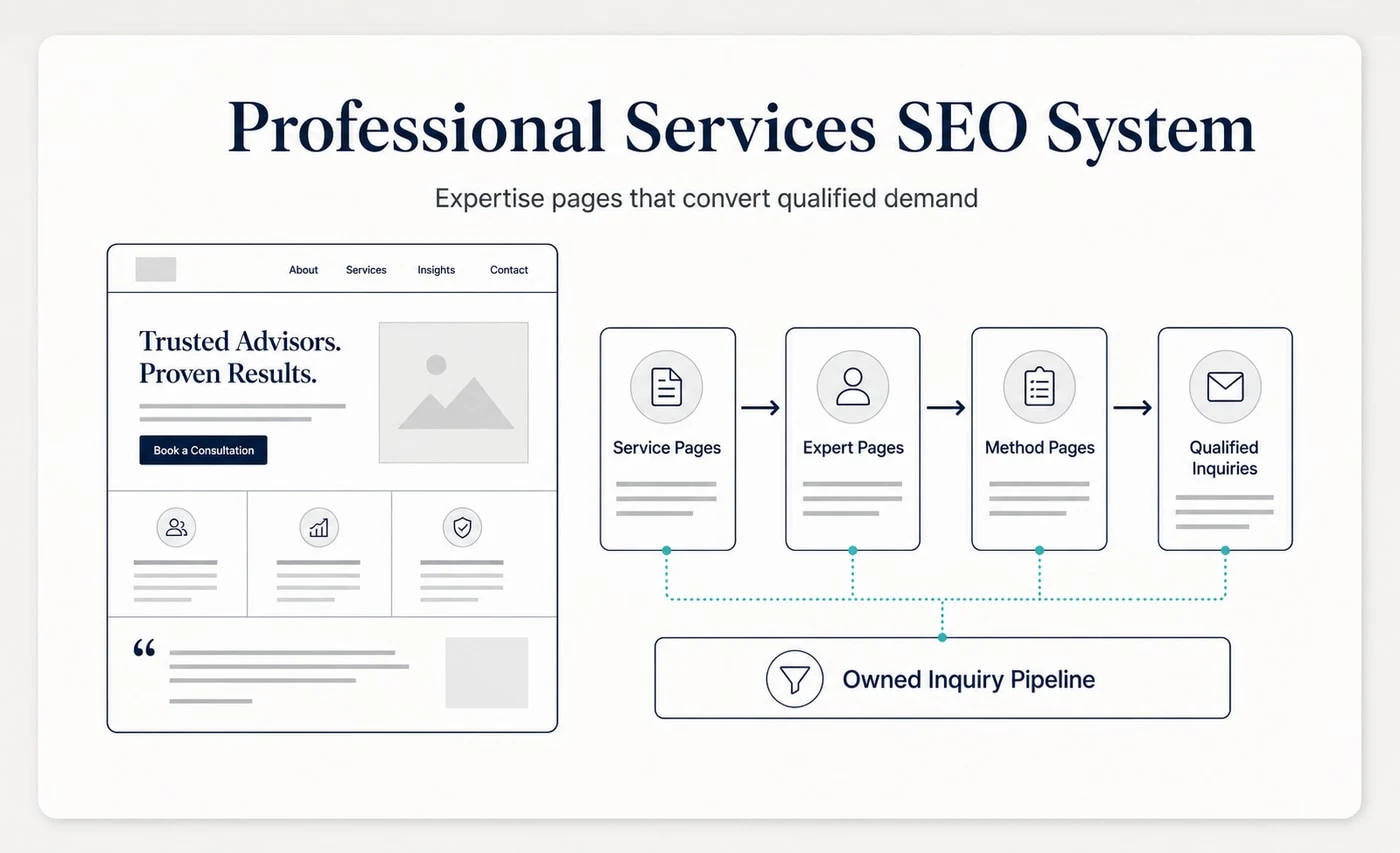
Groew Professional Services SEO service visual showing service pages, expert pages, method pages and qualified inquiries connected to an owned inquiry pipeline.

A problem-first professional services search system built around expertise pages, methodology clarity, and qualified inquiry flow.

Buyers Search for Their Problem. Your Website Describes Your Service.

A managing director evaluating consultants does not search for "management consulting firm." They search for the specific problem they are trying to solve: "how to reduce supply chain costs in manufacturing" or "fractional CFO for SaaS companies." A business owner looking for IT support searches for "managed IT services for dental practices" or "cybersecurity compliance for healthcare small business." When your service pages are built around internal service descriptions instead of buyer problem language, you are invisible at the exact moment a buyer is actively looking for what you do. That is the gap every professional services audit finds first.

The Search Infrastructure We Build for Professional Services Firms

This is not a content calendar or a keyword report. We install organic search infrastructure that generates qualified consultation requests the way a strong referral network generates introductions: consistently, from buyers already looking for what you do, without depending on any single relationship to keep it running.

01

Problem-First Service Pages That Rank for Buyer Intent

Most consulting and advisory firm pages describe the service. Buyers search for the problem. A procurement director searching for "managed IT services for healthcare companies" needs a page that answers that specific query, not a page that says "we offer comprehensive IT management solutions." We rebuild every service page around the specific problem queries your target buyers use, with named practitioner credentials and a clear consultation path on every page.

02

Expertise Infrastructure That Converts Thought Leadership into Inquiries

Most professional services firms have thought leadership content that ranks but never converts. Articles get traffic. Visitors read and leave. The missing piece is the link architecture that routes awareness traffic to service pages and the commercial page quality that converts it. We build the internal linking system, topic clusters around specific problem areas, and E-E-A-T signals that satisfy Google's expertise standards for advisory content. See how SEO content strategy builds this infrastructure.

03

Named by AI When Buyers Research Their Problem

Buyers increasingly use AI assistants during the initial research phase. When a VP of Operations asks Perplexity which consulting firms specialize in supply chain optimization for mid-market manufacturers, the AI cites firms with entity-dense, structured content naming the specialization, the methodology, the industries served, and the practitioners. Generic "we offer consulting services" descriptions earn nothing. Specific, structured expertise claims earn citations.

Alokk's perspective
Alokk, Founder at Groew
Alokk Founder and Lead Growth Architect, Groew
Professional services firms almost always have the same structural problem: every service page describes what the firm does, not what the client is searching for. When I audited one East Coast managed IT firm, their homepage led with their founding year, their certifications, and a list of service names. Not one page was built around a specific client problem. We rebuilt the service pages around the specific queries their target buyers use: "managed IT support for medical practices," "cybersecurity compliance for healthcare," "24/7 IT helpdesk for small business." Within 90 days the first organic inquiries arrived. Eight per month for 16 consecutive months. The referral pipeline did not disappear. It now has a parallel channel that does not depend on any single relationship staying warm. That is what Revenue Infrastructure looks like for an expertise-led business.

Professional Services SEO Questions

Commercial page rebuilds and problem-first content restructuring typically produce measurable inquiry improvement within 60 to 90 days. For one East Coast managed IT services firm, first organic gains appeared in 90 days and consistent inquiry volume reached 8 qualified leads per month by month four, sustained for 16 consecutive months. Infrastructure-first returns faster than content-first because it converts existing traffic rather than waiting for new traffic to arrive.
The difference is search intent. Buyers do not search for a consulting firm by service category. They search for their problem: managed IT services for healthcare, supply chain strategy consultant, fractional CFO for SaaS startup. Generic SEO targets category keywords. Professional services SEO maps every service page to the specific problem queries the target buyer uses. The firms that rank are those whose pages answer the buyer's problem before asking for a meeting. Learn more about organic search infrastructure built for B2B service businesses.
Yes. When a buyer asks ChatGPT, Perplexity, or Gemini which firms specialize in a specific consulting problem or service area, the AI cites pages with entity-dense, structured content naming the specialization, methodology, industries served, and named practitioners. Generic firm descriptions earn no citations. Groew builds FAQPage schema, named entity optimization, and problem-first content that earns AI citations across both Google and AI platforms. Use the AI brand visibility checker to see where your firm stands today.
Client confidentiality is standard in professional services. Groew builds credibility through anonymised outcome descriptions, named practitioner credentials, methodology documentation, and third-party validation signals that do not require client identification. Problem-solution-outcome page structures demonstrate capability without naming clients. One national professional services firm reached 404% organic conversion growth using this approach without naming a single client.
In order of conversion impact: problem-first service pages that rank for specific buyer queries, practitioner pages surfacing named expertise and industry focus, methodology pages explaining the engagement approach, FAQ content addressing buyer due diligence questions, and thought leadership linked to service pages so awareness traffic converts. Blog volume without strong commercial pages produces readers who never become prospects. Fix the service pages first.
Three steps. First, map the specific problem queries each buyer persona uses during active search. Not broad category terms. Second, rebuild service pages so the page answers the specific problem before describing the firm. Third, build topic clusters of supporting content that link back to service pages so authority flows from awareness to conversion. Use the topical authority checker to see which problem areas your site currently covers and which are gaps.
Thought leadership builds awareness and earns trust. Commercial pages convert that awareness into consultation requests. Most professional services firms over-invest in thought leadership and under-invest in commercial pages. The fix is not less content. It is building strong service pages first so that every thought leadership piece has a destination to link back to. Without problem-first service pages, thought leadership traffic has nowhere to convert.
Groew's infrastructure sprint starts at $3,000 USD per month. Professional services engagements vary based on the number of service lines needing commercial page rebuilds, the number of practitioner pages required, and whether content strategy or technical SEO is the primary gap. The establishes scope before any commitment. The audit report is yours to keep regardless of what you decide next.
Ask two questions. Do they lead with problem-first service page strategy or content volume? And can they show qualified inquiry growth from organic, not just traffic? Traffic from generic consulting terms rarely converts. Inquiries from specific problem queries do. Ask to see examples of service pages rebuilt around buyer intent and what the conversion impact was. An agency measuring success by session counts is solving the wrong problem for a professional services firm.
Infrastructure-first SEO is particularly effective for long sales cycles. A managing director researching a consulting firm searches 6 to 12 months before issuing an RFP or making first contact. The problem-first service page that answers their exact query today becomes the firm they shortlist when the engagement budget opens. For one national professional services firm, this approach produced 404% organic conversion growth over 18 months. Long cycles reward compounding assets. Referral networks plateau. Owned organic infrastructure does not.
From Groew's Search Authority Team

What We Find When We Audit Professional Services Firms, and What We Build First

The gap is the same across every professional services audit. The firm's expertise is real and often extensive. The online presence reflects none of it in a way buyers can find. Service descriptions are generic. Methodology is unstated. Results, where they exist, are locked in PDFs or restricted by confidentiality agreements. Here is what the audit consistently reveals and what gets built first.

What the Audit Reveals on Every Professional Services Website

The service pages describe what the firm does, not what the client's problem is. There are no pages built around the specific queries buyers use during active vendor research. A managing director searching for help does not search the service category name. They search their problem: the integration failure, the compliance gap, the operational bottleneck. The pages that rank are built around those queries. The pages that do not rank are built around the firm's self-description. When we audit a professional services site, the finding is almost always the same: the site was built to impress existing contacts, not to acquire new ones. The first build step is always problem-first pages, not more content. Story 7 saw 8 qualified leads per month from organic within 16 months of this rebuild, with the first gains in under 90 days.

Read the complete guide

The Three Buyer Roles in Professional Services and What Each Searches For

The CEO or Managing Director searches for strategic outcomes and firm reputation signals: "top strategy consulting firms for private equity portfolio" or "management consulting for operational turnaround." They are validating fit and credibility before any contact. The VP or Director-level operational decision maker searches for specific capability: "managed IT helpdesk for multi-location business" or "HR consulting for manufacturing compliance." They are actively sourcing. The procurement or vendor management function searches for credentials and pricing structure: "ISO 27001 certified managed IT provider" or "consulting firm retainer vs project pricing." Each of these three roles needs a different page built around their specific query. One generic "services" page serves none of them.

How to Build Credibility Online When Confidentiality Limits Case Study Detail

Client confidentiality is the most common objection professional services firms raise when asked for proof. The solution is not to avoid proof. It is to build proof that does not require client identification. Anonymised outcome descriptions with specific metrics and timelines (without naming the client) demonstrate capability. Named practitioner credentials with verifiable backgrounds establish expertise. Methodology documentation that explains the engagement approach signals rigour. Third-party signals such as media mentions, speaking engagements, and industry associations provide external validation. Together these build the same trust that named case studies provide, without requiring any client to be identified. One national data infrastructure firm reached 404% organic conversion growth using this approach across 18 months.

How to Build a Topic Cluster That Converts Thought Leadership into Consultation Requests

The architecture that converts awareness content into qualified inquiries works in three layers. Layer one: the commercial service page, built around a specific problem query, with named practitioner expertise and a clear consultation path. This is the conversion destination. Layer two: supporting articles that address specific questions buyers have while researching the problem. Each article links back to the service page. Layer three: the FAQ and methodology content that answers due diligence questions buyers ask before committing. Each FAQ answer links to the relevant service page. When this architecture is in place, a buyer who reads an article about their problem is one internal link away from the page that turns awareness into a consultation request. Without it, thought leadership traffic reads and leaves.

How AI Systems Decide Which Consulting Firms to Cite

When a buyer asks an AI assistant to recommend consulting firms for a specific problem, the AI draws from pages with the highest named entity density for the relevant specialization. A page that states "we provide managed IT services for healthcare organizations including HIPAA compliance management, electronic health record system support, and 24/7 helpdesk for clinical staff" gives the AI named entities to extract: the service type, the industry, the compliance standard, the specific capabilities. A page that says "we offer comprehensive IT solutions" gives the AI nothing. Professional services firms that earn AI citations are those that have named their specializations, named their industries, and named their methodologies explicitly on their commercial pages. Entity density and structural specificity determine citability more than content length.

Why Organic Authority Is the Permanent Alternative to Referral Dependency

Most professional services firms operate under referral dependency without naming it as such. The pipeline is controlled by a network of relationships that can go quiet at any time. A founding partner retires. A loyal client changes roles. An industry contact gets acquired. None of these events affect an organic inquiry pipeline built on problem-first page infrastructure. The page that ranks for "managed IT services for healthcare companies" continues generating qualified inquiries whether the firm's network is active or dormant. This is the Revenue Infrastructure model applied to professional services: build the owned channel once, maintain it, and it compounds. The firms that understand this stop treating organic as a marketing project and start treating it as a balance sheet asset.

Find Out What Your Professional Services Site Is Missing

A 30 minute call. No pitch deck. We audit your service pages, problem-intent gaps, and inquiry conversion path and tell you exactly what to fix first.

Best fit for management consulting firms, managed IT service providers, advisory practices, fractional executive firms, accounting and CPA firms, and HR consulting companies where most new business still comes from referrals. Groew does not work with solo freelancers, staffing agencies, or companies whose service model requires no direct client inquiry path.

ESC