Ecommerce SEO That Turns Search Demand Into Product Discovery
Groew builds ecommerce SEO systems for product, category and collection pages so search demand turns into qualified product discovery, not just impressions that never convert.
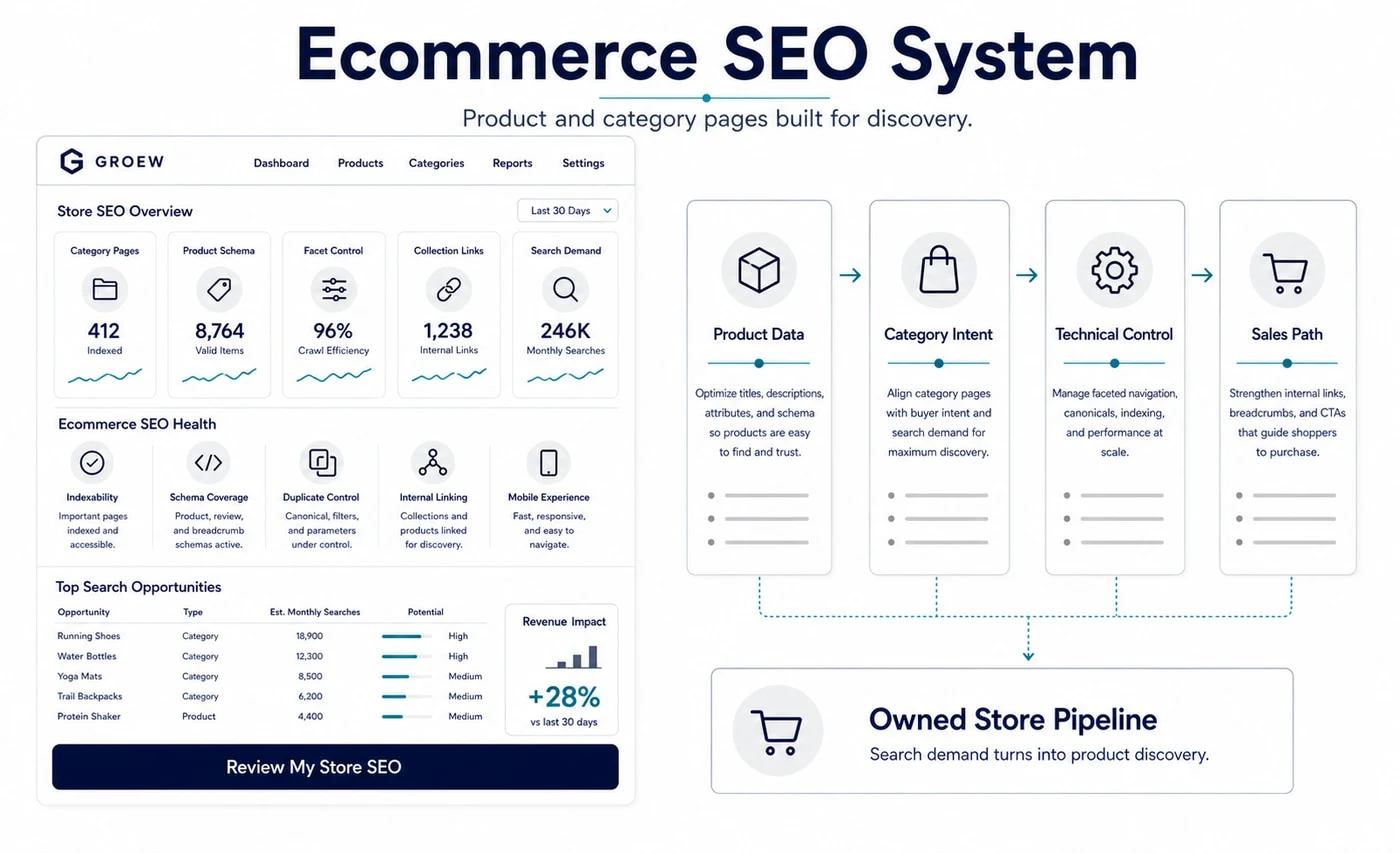
An ecommerce SEO system built around product data, category intent, technical control and the sales path.
What we fix in ecommerce SEO.
Category pages with no commercial intent content
Auto-generated category pages that show only a product grid, a filter bar and a category name. Google has no reason to rank them above a competitor page that actually explains what the category offers and who it is for.
Duplicate content from product variants and filters
Colour, size and material variants generating hundreds of near-identical URLs. Faceted navigation filters creating thousands of duplicate pages crawled by Google. Both patterns dilute the authority of the canonical product page.
Product pages that rank but do not convert
Thin product descriptions copied from manufacturer specs with no buyer context, no trust signals, no FAQs and no proof. Pages that rank but do not answer buyer doubts produce traffic that leaves without purchasing.
Missing structured data for rich results
Product pages without Product schema, price, availability or review data. Google cannot display star ratings, pricing or stock status in search results, which reduces click-through rate against competitors who have implemented structured data correctly.
What you get.
01
Product and category audit
Full review of category page content, product page structure, duplicate URL patterns, faceted navigation handling and structured data gaps. Priority ordered by revenue impact per page type.
02
SEO template for product and category pages
Page templates that include buyer-intent content, proof blocks, FAQ sections, internal links and structured data for both category and product page types. Reduces manual effort per page significantly.
03
Category page architecture
Internal link plan connecting search queries, category pages, subcategory pages and product pages into a hierarchy Google can crawl efficiently. Includes a plan for faceted navigation control and canonical implementation.
Alokk's perspective
AlokkFounder and Lead Growth Architect, Groew
The most overlooked pages in ecommerce SEO are category pages. Stores spend weeks writing product descriptions and ignore the category pages that rank first and send the most traffic. A category page with no content above the product grid is asking Google to rank it on brand authority alone. The stores that compound organically are the ones that treat every category page as a buyer question that needs a clear answer before showing the product grid.
Ecommerce SEO questions answered.
Ecommerce SEO optimises product pages, category pages and collection pages to rank for the queries buyers use when researching or ready to purchase. It also covers technical elements specific to online stores: faceted navigation, duplicate product variants, thin category pages and structured data for products.
Most category pages are generated automatically with only a product grid and a category name. They have no introductory content, no buyer-intent text, no internal links to informational pages and no schema. Google has no reason to rank them above a more informative page from a competitor.
Product variants (different sizes, colours, materials) often generate near-identical pages. Groew uses canonical tags to point variant pages to the main product, or consolidates them into a single page with in-page variation selection, depending on the search volume for specific variant queries.
Product pages should use Product schema with price, availability, review count and rating. Category pages benefit from BreadcrumbList and ItemList schema. Reviews should use Review and AggregateRating schema. Groew implements the full structured data set that enables rich results in Google Shopping and organic search.
Yes, but only if the content connects to commercial pages. Blog content that answers research questions and links to relevant category or product pages builds topical authority and supports product page rankings. Blog content disconnected from the product architecture produces traffic without sales.
From Groew's Search Authority Team
How ecommerce SEO connects search to sales
Ecommerce SEO is not just about ranking. It is about building a path from the search query to the sale that removes every friction point along the way.
Category pages are the most leveraged fix
A strong category page ranks for broad commercial queries, filters buyers into the right product section and passes authority to the product pages below it. A weak category page does none of these things. Because most ecommerce traffic enters through category pages before product pages, improving category page content and structure often delivers the largest traffic and revenue impact for the smallest amount of work. Groew always starts an ecommerce audit at the category level.
Faceted navigation must be controlled carefully
Faceted navigation allows buyers to filter by size, colour, price and attributes. Without canonical controls, each filter combination generates a unique URL. A store with 200 products and 10 filter options can create tens of thousands of crawlable URLs. Google wastes crawl budget on these pages instead of indexing priority commercial pages. The fix is canonical tags pointing filter URLs to the root category, combined with robots directives for combinations that provide no ranking value.
Structured data unlocks rich results
Google displays product price, availability, review stars and stock status directly in search results for pages with correctly implemented Product schema. These rich results increase click-through rate significantly against competitors showing only a title and description. For high-ticket products, showing price and reviews in the search snippet often pre-qualifies buyers before they click, improving the quality of traffic that reaches the product page.
Organic search is an owned sales channel
Every category page that ranks without ad spend is a permanent owned asset in the Revenue Infrastructure. Unlike paid shopping campaigns, organic category rankings compound over time, do not reset when a budget is paused and reach buyers earlier in the research journey before they have selected a brand. Ecommerce SEO converts the store from a digital tenant into a digital landlord with owned commercial visibility.
Turn search demand into sales, not just traffic.
If the store ranks but does not convert, or category pages are invisible in organic search, a structured ecommerce SEO audit will show exactly where the path from query to sale breaks down.
Get My Free Growth Audit.
No pitch deck. No retainer proposal. An honest read of where your organic growth is blocked and what a 90 day sprint would realistically produce.
Alokk, Founder, Groew
What is your name?
press Enter ↵
What is your email address?
press Enter ↵
Your company website
press Enter ↵
What is your role?
press Enter ↵
Where are you based?
press Enter ↵
What type of business is this?
What are your most important products or services?
Include target verticals and the industries you serve.
Shift + Enter for new line
Are you interested in SEO, AI search visibility, or both?
When are you looking to make a decision?
Estimated monthly budget for SEO, content and links?
All prices in USD. $3,000 USD ≈ £2,400 / AED 11,000.
How did you hear about Groew?
press Enter ↵
Anything else I should know? (optional)
Numbers, timelines, what you have already tried.
Ask AI about Groew
Open Gemini with a guided prompt
Copy the prompt first, open the AI tool next, then paste it into chat to get a grounded answer about Groew.