Architecting Authority

Authority Signals

Digital PR And Authority For B2B Search Trust.

Groew builds credible mentions, proof assets, expert references and citation paths that help Google, AI systems and serious buyers trust your company before the first call.

Trust Graph Proof Mentions Expertise Citations

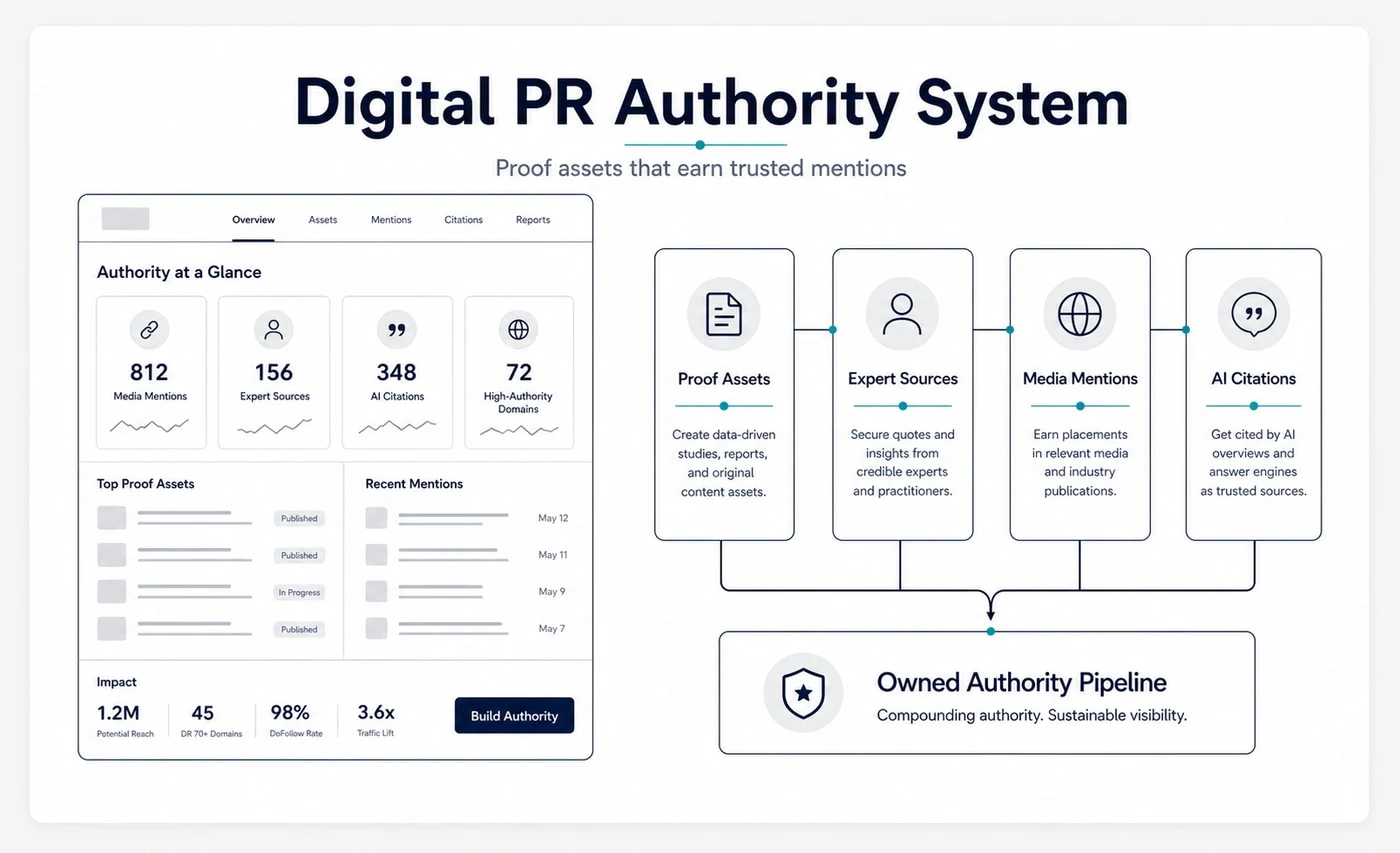
Authority works when proof, mentions, expertise and citation paths reinforce the same business story. A link without context is weaker than a trust signal buyers can verify.

Fast Answer

Digital PR is not a link package. It is trust infrastructure.

For a B2B company, authority is the evidence outside and around your website that confirms your claims. Google looks for signals. AI systems look for cross source agreement. Buyers look for proof. Groew connects all three with credible mentions, expert references, proof assets, profile cleanup, review signals and internal paths back to the pages closest to revenue.

Authority Map

The trust signals Groew builds and improves.

Authority work should make the company easier to verify, cite and trust. These are the signal types we look for before any outreach starts.

Credible mentions

Mentions on relevant sites, directories, publications and partner pages that a serious buyer would trust.

  • industry fit
  • source relevance
  • brand context

Expert references

Founder views, subject matter notes and useful quotes that make the company easier to understand and cite.

  • founder view
  • expert quote
  • clear source

Original proof assets

Data pages, client stories, screenshots, benchmarks, process notes and practical evidence competitors cannot copy.

  • real data
  • proof page
  • source path

Review and profile signals

Company profiles, review surfaces, author pages and social proof checked for accuracy, consistency and trust.

  • profile cleanup
  • review path
  • author trust

Link worthy pages

Useful pages that can earn links because they contain data, tools, comparisons, templates or operational insight.

  • data asset
  • tool asset
  • comparison page

Citation paths

Internal and external paths that connect your claims, proof, services, case evidence and founder expertise.

  • internal links
  • case evidence
  • AI clarity
Industry Fit

Authority changes by industry. The proof must match the buyer.

A SaaS buyer, a manufacturing buyer and a financial services buyer do not trust the same signals. Groew maps authority work to the market, not to a generic outreach list.

B2B SaaS

SaaS buyers compare vendors, integrations, risk, pricing logic and proof before they speak to sales. Authority work should support category pages, comparison pages, review profiles and integration proof.

  • comparison evidence
  • integration proof
  • review profile audit

Manufacturing

Industrial buyers need capability proof, product detail, certifications, lead time clarity and supplier trust. Authority comes from useful technical pages, specification assets and relevant industry references.

  • capability proof
  • specification assets
  • supplier trust

Financial services

Trust sensitive markets need founder credibility, risk clarity, compliance aware pages and proof that serious buyers can verify. Authority cannot depend on generic blog mentions.

  • trust pages
  • founder credibility
  • verified proof

IT services

Managed service and IT buyers search by problem, location, security concern and service need. Authority work should strengthen local proof, service expertise and review signals.

  • service proof
  • local trust
  • buyer concerns

Data and cybersecurity

Technical buyers need clear explanations, risk evidence, security language and credible references. Authority grows when technical proof is visible and easy to cite.

  • technical proof
  • risk evidence
  • security context

Professional services

The founder, team and client proof carry more weight than generic service claims. Authority work should connect experience, outcomes, publications and client evidence.

  • team proof
  • client evidence
  • expert viewpoint
Founder Risk

Weak authority work can make a good company look small.

Many B2B companies have strong delivery but weak public evidence. The website makes claims. Competitors appear in more places. Review profiles are thin. Founder expertise is not connected to service pages. Case stories are buried. AI tools cannot explain why the company should be recommended.

The result is not only lower rankings. It is weaker buyer confidence at the exact point where the buyer is comparing risk.

What Changes

Groew makes authority visible and connected.

  • Proof before outreach We strengthen the evidence buyers and publishers can reference before asking for attention.
  • Relevance before volume One useful mention in the right context is stronger than many weak links.
  • Commercial support Authority work points back to the service, industry, case and proof pages that support enquiries.
Deliverables

What Groew includes in Digital PR and authority work.

The output is a practical authority system your founder, SEO lead, content team and sales team can use. It is not a spreadsheet of random link targets.

Authority gap audit across competitors, search results, AI answers and buyer trust surfaces
Competitor mention map showing where competing brands are cited, listed or referenced
Industry proof map that decides which trust signals matter for the buyer category
Link worthy data asset, tool, comparison page, client story or operational resource plan
Founder authority profile with clear expertise, proof, author signals and citation ready context
Expert commentary angles for relevant publications, podcasts, partner pages and industry resources
Case story distribution map connecting proof pages to service pages and commercial search intent
Review, profile and directory cleanup so brand facts stay consistent across visible surfaces
AI citation source path connecting brand, service, proof, founder expertise and supporting pages
Internal proof link map so authority supports the pages closest to enquiries
Quality Control

What we refuse to build.

No link farms A weak link that exists only to manipulate rankings can damage trust instead of building it.
No domain score packages Domain score is not a business outcome. Relevance, context and proof matter more.
No fake guest posts A buyer can feel low quality outreach. Google can usually detect the same pattern.
No irrelevant directories A listing should help a buyer, confirm the business or support a real market signal.
No press release spam A release without useful news does not create authority. It creates noise.
No outreach before proof Authority work is weaker when the website has no strong proof assets to reference.
AI Search

AI systems need agreement across sources.

When buyers ask ChatGPT, Perplexity, Gemini or Google AI about a vendor category, the systems look for clear entities, repeated facts, credible mentions and pages that explain the business without ambiguity.

  • Entity clarity The company, founder, service, proof and category signals should agree across public pages.
  • Source depth Case stories, data assets, expert pages and industry references give AI systems more reliable context.
  • Citation readiness Useful summaries, schema, author signals and internal links make the source easier to quote and understand.
Search Support

Authority should support the pages that create pipeline.

Digital PR should not sit apart from SEO. The authority assets need to support homepage trust, service pages, industry pages, comparison pages, client stories and the content that answers buyer questions before the call.

That is why Groew connects authority work to SEO content strategy, SEO landing pages and AI search visibility. The system matters more than any single mention.

Proof Signal

Authority becomes valuable when it supports revenue pages.

Groew does not present these outcomes as Digital PR alone. They came from Revenue Infrastructure: technical fixes, content architecture, commercial pages, proof assets, internal links and authority signals working together.

For the US investment firm story, trust sensitive commercial pages helped organic visibility convert into $17.5M plus in new investor capital. For the data security SaaS story, stronger service and proof signals supported $4.2M ARR from organic search.

Read My Client Stories →
$17.5M+ new investor capital attributed to organic growth
$4.2M ARR from organic search for a data security SaaS story
120+ monthly quote requests from organic search
1.04M organic impressions in 90 days for a client build
Alokk's perspective
Alokk, Founder at Groew
Alokk Founder and Lead Growth Architect, Groew
When I review authority for a B2B company, I do not start by counting links. I start by checking whether a serious buyer can verify the company from more than one source. In the investment firm story, organic visibility only mattered after the trust layer was strong enough for high value buyers to act. That work helped turn search authority into $17.5M plus in new investor capital. Authority is strongest when it supports the whole revenue system.
Questions

Common questions about Digital PR and authority.

Digital PR for SEO is authority work that earns credible mentions, useful references, relevant links and proof signals around a brand. For B2B companies, it works best when it supports service pages, case stories, industry proof and buyer trust.
No. Link building often focuses on acquiring links. Digital PR and authority work focuses on the larger trust system: mentions, expert references, original data, proof assets, profiles, reviews, case evidence and relevant links.
Backlinks can still matter when they are relevant, credible and connected to a real proof asset. Weak links from unrelated sites are not a strong authority strategy for B2B companies.
Yes. AI systems look for cross source agreement. Clear mentions, expert profiles, case evidence, structured pages and consistent brand facts make a company easier to understand and cite.
Most B2B companies should first fix proof pages, service pages, founder expertise, review profiles and internal links. Outreach performs better after the website has evidence worth referencing.
From Groew's Search Authority Team

How to build authority before outreach starts

Authority work is stronger when the proof exists before the pitch. The goal is not to collect mentions. The goal is to make the company easier to trust, rank, cite and choose.

Start with the proof inventory

The first question is simple: what can a buyer verify? A company may have strong delivery, but if the proof is hidden inside sales decks, private emails or internal dashboards, search systems and buyers cannot use it. Groew starts by listing proof assets that already exist. Case numbers, screenshots, client industries, founder experience, original observations, customer quotes, technical process notes, certifications and data points all belong in the inventory.

The next step is deciding which proof should become public and which proof should stay private. Not every client name can be used. Not every number can be published. A strong authority system can still work with anonymised proof when the context, timeframe and method are specific enough to feel real.

Read the complete guide

Match authority to the buying risk

Authority is not the same in every market. A SaaS buyer may trust integration proof, comparison pages, product category mentions and review platforms. A manufacturing buyer may trust specification pages, certifications, supplier references and detailed capability proof. A financial services buyer may need founder credibility, regulatory context, client type evidence and careful risk language. If the authority plan ignores the buying risk, the work becomes generic.

This is why Groew maps industry proof before outreach. The map shows what a serious buyer would check, where competitors already appear and which missing signals create doubt. The best authority work closes those gaps first.

Build assets that deserve references

Outreach performs better when the company has something useful to reference. A clear benchmark, tool, client story, original field note or comparison page gives a publisher, partner or industry site a reason to mention the brand. A generic service page usually does not.

For B2B companies, useful assets are often practical rather than flashy. A cost calculator, migration checklist, buyer question map, implementation teardown, industry benchmark or anonymised case story can earn more trust than a polished announcement. The asset should help the market understand something better. That usefulness is what makes the authority signal durable.

Connect external trust back to commercial pages

A mention is only useful if it strengthens the system. If every external signal points to the homepage while the service pages remain weak, the authority does not fully support conversion. Groew connects mentions, proof pages and expert references back to the pages that create enquiries.

This is where internal linking matters. A client story should support the relevant service page. A tool should support the relevant SEO service. A founder perspective should connect to the commercial page where the buyer makes a decision. Authority should not sit in a corner of the site. It should move trust toward revenue pages.

Keep brand facts consistent across public sources

AI systems and search engines rely on repeated facts. If one profile says the company is an SEO agency, another says growth studio and another says web design agency, the entity becomes harder to understand. In B2B categories, that confusion can weaken trust before a buyer ever reaches the site.

Profile cleanup is not glamorous, but it matters. Company name, service category, founder role, location, client type, proof numbers and social profiles should agree across the visible web. Clear repetition helps search systems classify the business and helps buyers feel they are seeing the same company everywhere.

Measure authority by quality, not volume

The easiest authority report to fake is a link count. The harder report is whether the authority work helped the brand become more trusted in the right market. Groew looks at quality signals: source relevance, referral context, branded search movement, AI mentions, commercial page support, ranking movement and enquiry quality.

A small number of strong signals can outperform a larger number of weak mentions. The right question is not how many links did we get. The right question is whether buyers, Google and AI systems now have better reasons to trust the company.

Treat authority as Revenue Infrastructure

Authority is not a campaign when it is built properly. It becomes part of the owned system. Proof pages keep supporting sales. Client stories keep supporting service pages. Expert views keep supporting AI answers. Useful tools keep earning attention. Clean profiles keep confirming brand facts.

This is the difference between rented visibility and owned trust. Paid campaigns stop when spend stops. Weak outreach fades. A real authority system compounds because it strengthens the website, the brand entity and the buyer journey at the same time. That is why Digital PR and authority belong inside B2B SEO Infrastructure, not beside it as a separate activity.

Next Step

Find the authority signals your market already expects.

We will review your category, competitor trust signals, proof assets and the pages that need stronger authority before buyers compare vendors.

Audit My Authority Signals
ESC