
Architecting Authority

SEO for Manufacturing Companies That Fill the RFQ Pipeline

Most manufacturer websites are built as product catalogs. Buyers cannot find them in search. We rebuild them as demand-generation assets that rank, convert, and send consistent quote requests without paid media.
See how the infrastructure sprint works
120+ RFQs/month in 7 months
410% Organic traffic growth
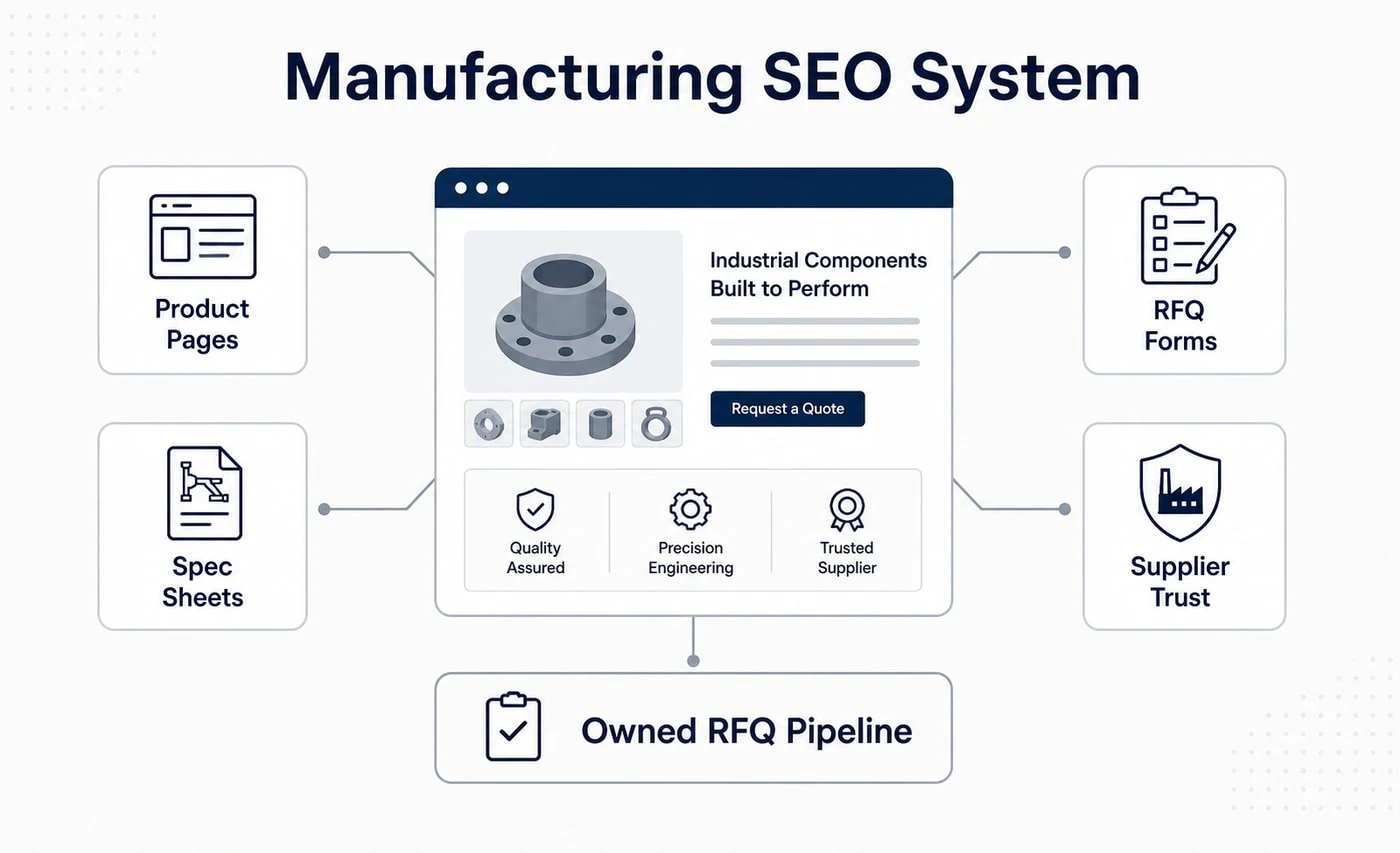
Groew Manufacturing SEO service visual showing product pages, spec sheets, RFQ forms and supplier trust connected to an owned RFQ pipeline.

A simple view of the owned manufacturing pages that turn product searches into quote requests.

Industrial Buyers Search on Google. Your Site Was Not Built for That.

Engineers and procurement managers searching for components, materials, and suppliers start on Google. They search with specification language: grades, tolerances, certifications, standards bodies. A site built as a product catalog has no pages that match these queries. Category pages with part numbers and brief descriptions do not rank for "304 stainless steel hex bolts ASME B18.2.1" or "ISO 9001 certified precision machining midwest." The buyers are searching. The commercial pages that should catch them simply do not exist. Every manufacturing audit finds the same gap: extensive catalog, invisible to the buyers most likely to convert.

The Commercial Infrastructure We Build for Industrial Manufacturers

This is not a content calendar or a keyword report. We install organic search infrastructure that generates RFQ volume the way a factory generates output: consistently, predictably, and without stopping when you stop paying.

01

Product and Capability Pages Built to Rank and Convert

Most manufacturer pages are catalog entries. We rebuild them as commercial assets: full specification context, application targeting, certification visibility, and a clear RFQ path above the fold. Engineers and procurement managers find what they need and convert without a sales call.

02

Catalog Architecture That Google Can Crawl and Index

Large product catalogs create crawl budget problems, duplicate content from faceted navigation, and thousands of thin SKU pages competing against each other. We fix the architecture so authority flows to the pages that matter, not spread thin across pages that cancel each other out.

03

Visible in ChatGPT and Perplexity When Buyers Search

B2B buyers increasingly use AI assistants during supplier research. When an engineer asks ChatGPT which suppliers can produce a specific component or material, it cites pages built for AI extraction. Thin catalog entries are invisible. We build the entity-dense, structured content that earns citations on both Google and AI platforms.

Alokk's perspective
Alokk, Founder at Groew
Alokk Founder and Lead Growth Architect, Groew
Manufacturing companies almost always have the same structural problem: the website was built to show what exists, not to be found by buyers who need it. The product catalog is complete. The quote path works. But the pages have no search intent alignment. When we audited one industrial equipment supplier, their 200 product pages had an average of 80 words each and no specification context. No engineer searching for that product would land there. After rebuilding the commercial pages with full specification depth, material grades, certifications, and clear quote paths, the site went from zero organic RFQs to 120 per month in seven months. That is not a content volume problem solved. That is a Digital Landlord model installed on an asset that already existed.

Manufacturing SEO Questions

Most manufacturing clients see initial ranking movement within 60 to 90 days after technical fixes and product page rebuilds go live. RFQ volume typically increases from month three onward as commercial pages accumulate authority. One US industrial equipment supplier reached 120 inbound quote requests per month by month seven, starting from a site generating no organic pipeline. Timeline depends on catalog size, current domain authority, and how competitive the target product categories are.
Industrial sourcing directories lost significant organic search visibility between 2023 and 2025 as buyers shifted to Google. Directories still help with verification searches from procurement teams who already know your name, but Google organic now controls the discovery phase. A buyer looking for a new supplier starts with a search query. Both channels can coexist, but Google organic is where the shortlist is built before your sales team is ever contacted.
Large catalogs require crawl budget management, canonical tag strategy, and faceted navigation controls that prevent thousands of duplicate URLs from spreading authority thin. We audit the catalog, prioritise high-intent product and category pages, suppress low-value filter combinations, and build page templates that scale without technical debt. Spec sheets and datasheets get semantic file naming and structured data so they are indexable and readable by AI platforms.
An RFQ-optimised product page ranks for the specific query an engineer or procurement manager uses during active sourcing, answers their specification questions without requiring a sales call, and has a clear quote path visible above the fold. Most manufacturer product pages are catalog entries with a part number and a brief description. An RFQ-optimised page includes material grades, tolerances, certifications, applications, and lead time context that industrial buyers need before submitting a quote request.
Manufacturing SEO targets three distinct roles simultaneously: engineers searching for specifications and compatibility, procurement managers comparing suppliers on certification and lead time, and operations directors looking for capacity proof. Generic B2B SEO optimises for one decision-maker query type. Manufacturing SEO also relies on different content assets: spec sheets, application pages, material guides, and capability pages drive RFQ conversions, not thought leadership blogs.
Yes. When an engineer asks ChatGPT which suppliers offer a specific capability or material, the AI cites pages built with entity-dense, well-structured content and proper schema markup. Manufacturers with optimised product and capability pages earn these citations. Companies with thin catalog entries do not. Groew builds FAQPage schema, structured data, and AI-readable content architecture into every manufacturing engagement so the site earns citations across both Google and AI search platforms. Use the AI brand visibility checker to test whether your manufacturing company appears in AI search results today.
In order of conversion impact: optimised product pages with full specifications and a quote path, capability pages ranked for application searches, material and grade guide pages that engineers consult during design, comparison pages that help procurement teams shortlist suppliers, and FAQ content that addresses sourcing objections. Blog content drives awareness but rarely drives quote requests directly. The RFQ pipeline grows when commercial pages are built to rank and convert, not when content volume increases without structure.
Groew's infrastructure sprint starts at $3,000 USD per month. Manufacturing engagements vary by catalog size, competitive intensity, and whether technical SEO or content production is the primary bottleneck. The establishes scope before any commitment. Groew does not charge for the audit, and the audit report is yours to keep regardless of what you decide next.
Infrastructure-first SEO is particularly well-suited to long procurement cycles. When an engineer or procurement manager researches suppliers 6 months before the budget opens, the product page that answers their specification question today becomes the supplier they remember when the RFQ is issued. The goal is to own the research stage, not just the decision stage. For one industrial equipment supplier, this approach produced 120+ inbound quote requests per month within 7 months. Long cycles reward compounding assets more than any other acquisition model.
From Groew's Search Authority Team

What We Find When We Audit Manufacturing Sites, and What We Fix First

The pattern across every manufacturing audit is the same. Individual product pages do not exist. Capability pages that rank for application searches are absent. Certifications are buried. The site was built as a catalog, not as a discovery asset. These are structural problems, not traffic problems. Here is what the fix looks like in practice.

What We Find When We Audit a Manufacturing Site

The pattern is consistent. The product catalog is extensive but individual products do not have standalone pages. Capability pages do not exist. Certifications are listed in a sidebar or PDF, not structured as indexed content. The site answers what the company makes, not what problems it solves for each buyer role. Engineers, procurement managers, and operations directors all search differently and for different evidence. A site built as a catalog fails all three. When we restructure a manufacturing site, the first step is always mapping buyer queries to missing pages, not adding content to existing ones. Story 4 saw non-branded visibility increase 70x after this restructure, with 40% more qualified opportunities year over year.

Read the complete guide

Why Product Pages Fail in Industrial Search

The most common mistake is a product page that lists a part number, a product name, and three sentences of copy. This is a catalog entry. It is not a ranking page. Google needs enough textual content to understand what the page is about and whether it matches a buyer's query. An industrial buyer searching for "304 stainless steel hex bolts with ASME B18.2.1 certification" needs to land on a page that answers that query completely. If your product page has no mention of the material grade or the certification standard, it will not rank for that query regardless of how good your domain authority is. The fix is not writing more blogs. It is rebuilding the commercial pages with the specification depth that buying-intent queries require.

The Catalog Architecture Problem

A catalog with 5,000 SKUs creates a crawl budget problem. Google has a limited number of pages it will crawl and index per site per day. If those crawls are distributed across thousands of thin variant pages, the pages that matter do not get indexed. Faceted navigation compounds this by generating thousands of URLs for every combination of size, material, and finish. Left unmanaged, this creates duplicate content that splits ranking signals and sends Google the wrong signals about which page represents the canonical version. The solution is not removing products. It is building a crawl architecture that signals which pages carry commercial intent and which are supporting structure.

Spec Sheets and Datasheets as SEO Assets

Most manufacturers upload PDF datasheets with filenames like doc_final_v3.pdf. This is a missed opportunity. A file named 304-stainless-steel-hex-bolt-asme-b18-2-1-specification-sheet.pdf carries semantic signal in the filename itself. Combine that with a properly structured HTML landing page that describes the document, adds FAQ content around common specification questions, and links to related product and capability pages, and the datasheet becomes a ranking asset. Engineers who download datasheets are in active sourcing mode. Capturing that intent organically puts your product on the shortlist during the design phase, before a procurement manager is even involved.

AI Citation as a Manufacturing Discovery Channel

Industrial buyers increasingly use ChatGPT and Perplexity during the research phase. When a design engineer asks an AI assistant which suppliers can provide a specific alloy, tolerance, or certification, the AI cites pages that have the right content structure. Entity density matters: a page that names the specific material grades, the applicable standards bodies (ASME, ASTM, ISO, MIL-SPEC), the applications, and the industries served gives AI models enough to extract a confident citation. A page that says "we supply high-quality metal parts" gives the model nothing to work with. Building for AI citation is not separate from building for Google. Both reward the same content qualities: specificity, structure, and genuine technical depth.

How the Revenue Infrastructure Model Applies to Manufacturing

Every inbound RFQ generated by organic search is a lead your business owns permanently. It does not disappear when you stop paying a directory subscription. It does not reset when an algorithm changes your paid ad cost. The page that ranks for a specification query will continue generating quote requests for years if it is built correctly. This is the owned growth system applied to industrial commerce: build the asset once, maintain it, and it compounds. The manufacturers who understand this shift away from transactional lead generation toward infrastructure investment. The ones who do not keep renting visibility from platforms they do not control.

Find Out What Your Manufacturing Site Is Missing

A 30 minute call. No pitch deck. We audit your product pages, RFQ intent gaps, and specification page coverage before any investment is discussed.

ESC