Architecting Authority

2.5 Million Organic Impressions. Ad Spend Down 82%. Inquiries Still Arriving.

Creative buyers search for specific deliverables in specific cities. A brand manager is not searching for photography services. They are searching for product photography agency or commercial video production. Generic SEO targets the broad term and misses every buyer who knows exactly what they need.
See how the infrastructure sprint works
220KImpressions in 6 Months
42.9KOrganic Clicks
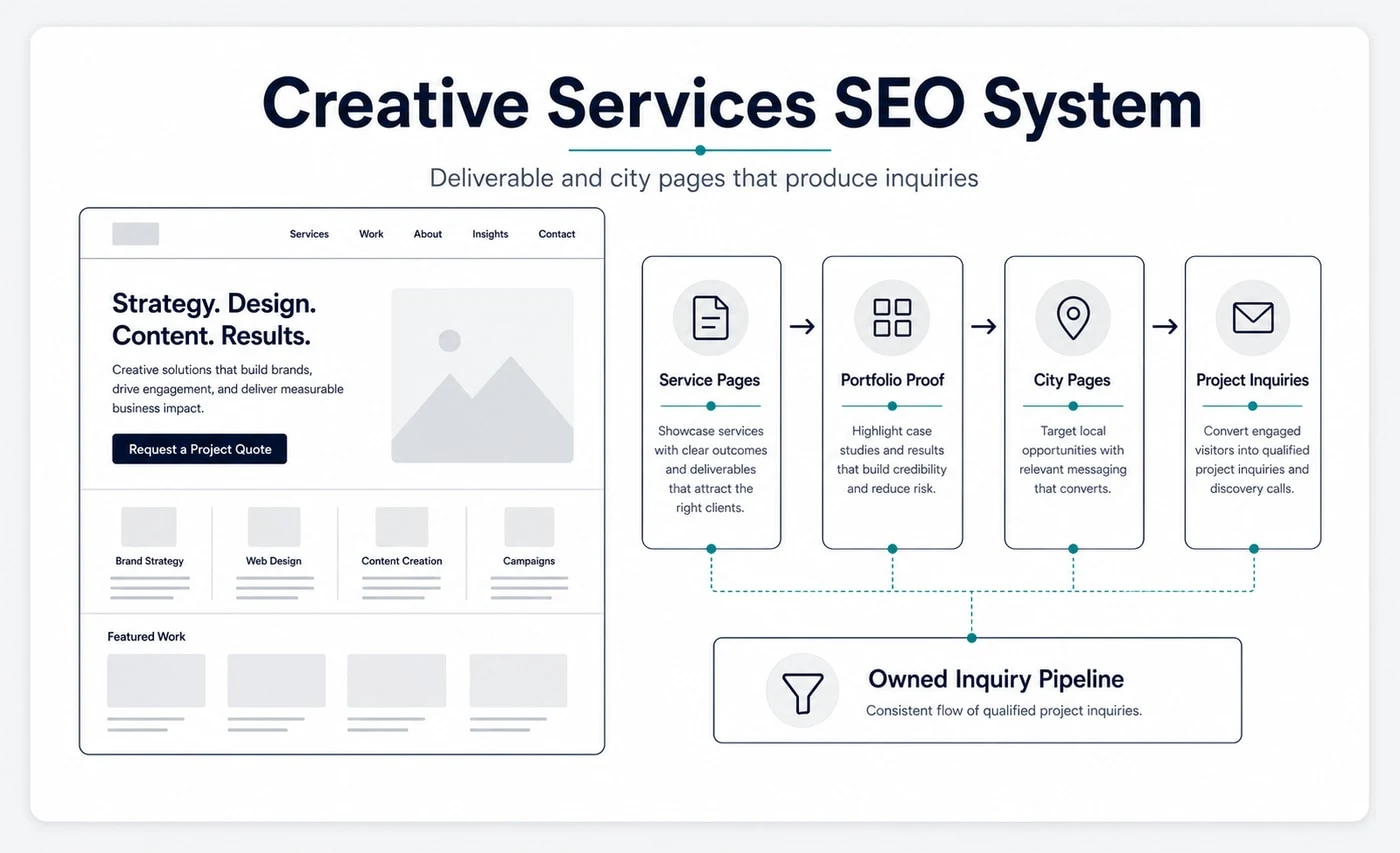
Groew Creative Services SEO service visual showing service pages, portfolio proof, city pages and project inquiries connected to an owned inquiry pipeline.

A creative services search system built around deliverable pages, portfolio proof, city visibility, and project inquiry flow.

Why Creative Studios Get Traffic But Not Inquiries

Most creative studio websites have one Services page that describes photography, video, and editing in three sentences. A brand manager searching for commercial product photography for an ecommerce launch or a corporate video production company for a recruitment campaign finds nothing on the site that matches their query. They find a competitor who built the page. The studio has a strong portfolio and almost no organic inquiry flow. Generic SEO treats a photography studio like a local business and targets broad terms that buyers who already know what they need are not using. What converts is a separate page for each deliverable, written for the buyer searching with that specific project brief in mind.

The Search Infrastructure We Build for Creative Studios and Agencies

This is not a portfolio refresh or a social content plan. We install organic search infrastructure that generates qualified project inquiries the way a referral network does: consistently, from buyers who already understand what they need before they make contact.

01

Deliverable Pages Built Around What Buyers Search for When They Have a Project

Creative buyers search for what they need to produce, not for a studio. A marketing manager looking for campaign photography searches for commercial photography for fashion brand or ecommerce product photography studio. A corporate communications team searches for corporate video production company or internal comms video production. We build separate service pages for each deliverable you offer, written for the buyer searching with that specific project in mind. Each page answers the query before the buyer needs to look elsewhere.

02

City Architecture That Puts the Studio in Front of Buyers in Every Market It Serves

A buyer scoping a product shoot in their city is not going to find a studio based only in another city, even if that studio is willing to travel. City-level pages are what capture market-specific search intent. We build genuine city-specific pages for every geographic market you operate in, pages that reflect the industries and client types common in that city, not a generic template with the city name swapped in. A pan-India creative marketplace we worked with reached 220,000 impressions and top 7 average position across 25 cities in 6 months using this approach.

03

Entity Architecture That Gets Your Studio Named When Buyers Ask AI for Creative Recommendations

When a brand manager asks ChatGPT for product photography studios for their next campaign, AI systems cite the studios that clearly define what they specialise in, the client types they work with, the cities they serve, and the formats they produce. A studio described only as creative and passionate gets cited by no one. We build the entity-dense content structure that puts your studio in those AI recommendations, naming your exact specialisations, client categories, and geographic markets so AI systems can include you in specific answers.

Alokk's perspective
Alokk, Founder at Groew
Alokk Founder and Lead Growth Architect, Groew
Creative studios are some of the most visually impressive sites I audit and some of the worst performers in organic search. The pattern is always the same: a beautiful portfolio, a single Services page with four paragraphs, and no pages built for what buyers actually search for. A brand manager does not search for photography studio. They search for commercial product photography for skincare brand or corporate video production company for recruitment. When we rebuilt the service architecture for a photo and video studio operating across five cities, organic impressions reached 2.5 million and ad spend fell 82 percent over 15 months. The studio did not stop running ads because ad performance dropped. They stopped because the organic channel was producing. That is the definition of Revenue Infrastructure for creative services: a permanent inquiry asset that does not reset when the ad budget is paused.

Creative Services SEO Questions

For photography studios and video production companies, first measurable gains in impressions and clicks typically appear within 60 to 90 days once service pages are rebuilt around what buyers search for. A photo and video studio across five cities reached 2.5 million organic impressions and 42,900 organic clicks over 15 months while reducing ad spend 82 percent. A creative marketplace reached 220,000 impressions and top 7 average position across 25 cities in 6 months.
Creative services buyers search by specific deliverable and location, not by generic studio type. A marketing manager searching for a photography partner is searching for commercial product photography for ecommerce or brand campaign video production, not photography services. Generic SEO targets the broad term and misses every buyer who is describing a specific project. Organic search infrastructure for creative businesses must be built around deliverable-specific language.
Yes. AI systems cite studios that clearly define their specialisations, client types, geographic coverage, and project formats. Studios with service pages naming specific deliverables such as product photography, corporate video, or event coverage appear in AI recommendations. Use the AI brand visibility checker to test whether your studio appears in AI recommendations today.
Engagements run as a defined sprint fee, not an open-ended monthly retainer. Everything delivered belongs to you permanently. There is no ongoing payment required to keep the infrastructure running. The best first step is a where we diagnose exactly what is blocking your inquiry flow before any investment is discussed.
Build an organic search channel that generates inquiries independently of ad spend. A photo and video studio we worked with reduced monthly ad spend by 82 percent over 15 months while organic impressions grew to 2.5 million. The organic channel was producing inquiries before the ad budget was cut, which made the reduction possible without losing inquiry flow.
The highest-value creative services keywords are deliverable and location queries: product photography New York, commercial video production for brands, corporate headshots Chicago, brand campaign photography agency, ecommerce product photography studio. These convert at a higher rate than generic photography studio keywords because buyers are describing an active project with a specific deliverable in mind.
Build genuine city-specific service pages for each geographic market you serve. Not pages that swap a city name into a template, but pages that reflect the industries, client types, and project types common in that city. A creative marketplace we worked with used this approach to reach top 7 average position across 25 Indian cities in 6 months. See how the infrastructure sprint works on our how we work page.
Social media builds awareness. Organic search captures buyers who already know what they want and are actively comparing options. A brand manager searching for a product photography studio for a campaign is not browsing Instagram looking for photographers. They are typing a specific query into Google or asking an AI tool. If the studio is not present in that moment, a competitor captures the brief.
Every creative business needs service pages organised by deliverable: product photography, corporate video, event coverage, brand campaigns, editorial, and headshots, each written for the buyer searching with that specific project. Plus city pages for every geographic market and industry pages for client types you serve best, such as photography for ecommerce brands, video for tech companies, or headshots for professional services firms.
From Groew's Search Authority Team

What We Find When We Audit Creative Studio Websites, and What We Build First

The pattern across every creative studio audit is the same. The site looks outstanding. The service page is a paragraph. There are no pages for the specific deliverables buyers search for, no city pages outside the home market, and the ad budget is doing work that organic search could replace permanently. When we rebuilt the service infrastructure for a photo and video studio operating across five cities, organic impressions reached 2.5 million and ad spend fell 82 percent over 15 months.

What the Audit Reveals on Every Creative Studio Website

The first finding on every creative services audit is the same: the site has one Services page describing photography, video production, and editing in three sentences. There are no pages for commercial product photography, no pages for corporate video production, no pages for ecommerce photography, no pages for any of the specific deliverables buyers search for when they have an active project. The portfolio is strong. The search infrastructure is absent. A brand manager searching for product photography for cosmetics brand or event videographer for corporate conference finds nothing on the site that matches their query. They find a competitor who built the page. When we built those pages for a five-city photo and video studio, organic impressions grew to 2.5 million over 15 months. The portfolio quality was there from the start. The infrastructure was the gap.

Read the complete guide

Why Creative Service Pages Fail to Convert Buyers

Creative service pages fail to convert because they are written from the studio's perspective, not the buyer's. A studio describes itself as a full-service creative production company offering photography, video, and post-production. A buyer describes their need as product photography for a new skincare line launching in Q3, or a two-minute recruitment video for our London office. There is no semantic overlap between the studio's description and the buyer's search query. The conversion gap is a language gap. Each service page needs to open with the deliverable the buyer is searching for, name the client type it serves, state the format and output clearly, and answer the questions that arise during the evaluation stage. That is the structural change that turns a portfolio site into a lead-generating asset.

How City Architecture Works for Creative Studios Serving Multiple Markets

A buyer scoping a product shoot or a corporate video in their city is not searching nationally. They are searching for photographers in Manchester, product photography studio New York, or videographers for events in Dubai. A studio based only in one city with no city specific pages is invisible in every other market, even if they travel to serve those markets regularly. We build genuine city pages for every geographic market a studio operates in, pages that reflect the industries, client types, and project types common in that city. The SEO system for New York City photographers is one example of this parent and area architecture. A pan India creative marketplace we worked with used a related architecture to reach 220,000 impressions and top 7 average position across 25 cities in 6 months from a standing start. Genuine specificity is what earns city level rankings.

How Creative Buyers Research Studios Before Making Contact

Brand managers and marketing teams evaluating creative studios go through a multi-step research process before making contact. They typically search by deliverable and location first, shortlist 3 to 5 studios based on search results and portfolio quality, review Google ratings and any third-party coverage, check how the studio presents its process and pricing, and then reach out to 2 or 3 for a brief conversation. A studio that appears in organic search for the initial deliverable query, ranks in local search for the city query, and has a website that speaks to the specific project type being evaluated wins before the conversation begins. Building that presence is what distinguishes a studio that relies on referrals and ad spend from one that generates a consistent organic inquiry flow from buyers who are already scoping a project when they make contact.

The Revenue Infrastructure Model for Creative Services Companies

Creative businesses are among the most ad-dependent in the B2B services market. Most photography studios and video production companies grow through referrals and through ad campaigns that generate inquiries as long as the budget is running. When the campaign ends, the inquiry flow stops. Revenue Infrastructure for creative services means building an organic inquiry channel that operates independently of any campaign or referral relationship. A photo and video studio we worked with reduced monthly ad spend by 82 percent over 15 months because the organic channel was already producing inquiries before the ad budget was cut. The infrastructure compounded. The ad dependency decreased. The studio now has an inquiry asset it owns permanently rather than a lead channel that requires ongoing payment to operate. That is the structural difference between a Digital Tenant and a Digital Landlord in creative services.

Find Out What Your Creative Studio Site Is Missing

A 30 minute call. No pitch deck. We identify which deliverable queries you are invisible for, which city markets you are not capturing, and what the highest-return fix is before any investment is discussed.

Best fit for photography studios, video production companies, creative agencies, and creative marketplaces with an existing portfolio and at least one defined service specialisation. Works best when the business serves 3 or more distinct deliverable types across a defined client category such as brands, professional services, or hospitality.

ESC