Architecting Authority

Commercial Pages

SEO Landing Pages That Turn Search Demand Into Qualified Enquiries.

Groew builds service, solution, industry, problem, comparison and regional pages around buyer intent, proof and one clear next action. These are the pages that turn rankings into pipeline.
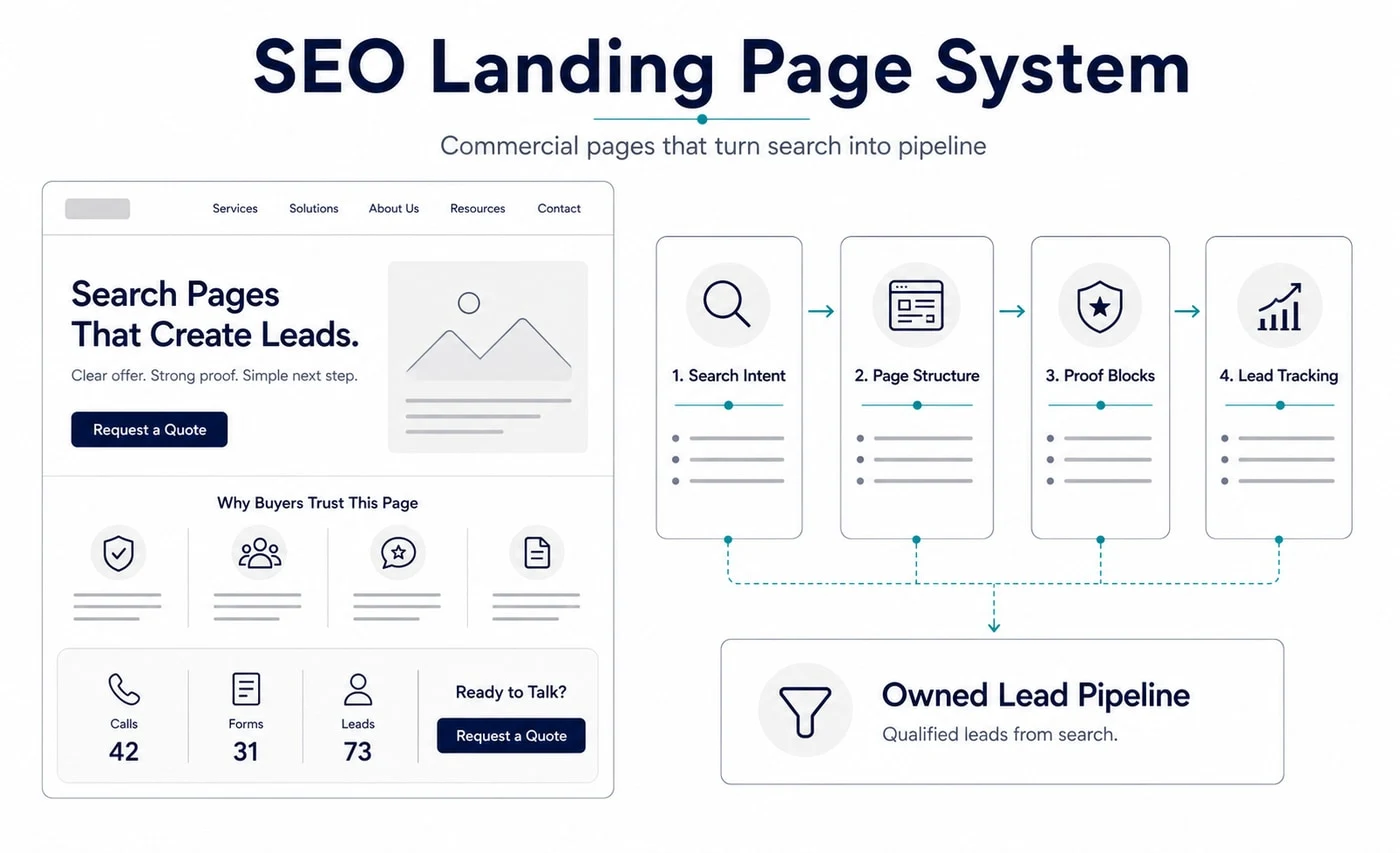
Commercial Page Map Demand Page Type Proof Enquiry

The page should connect search demand, the right page type, proof, internal links, CTA and lead tracking. Otherwise rankings do not become pipeline.

Fast Answer

An SEO landing page is a revenue page built for search.

It is not just a pretty landing page. It is a crawlable, indexable commercial page that matches search intent, answers buyer questions, proves trust, links into the rest of the site and guides the visitor toward an enquiry. Blog posts create attention. Commercial pages convert attention into pipeline.

Page Types

The commercial SEO pages Groew builds.

Every B2B site needs a different mix. We decide the page type from search demand, buyer intent, proof depth and conversion path.

Service Pages

Pages for core services where buyers already know the category and need to judge fit, proof and next action.

  • service intent
  • proof blocks
  • clear CTA

Solution Pages

Pages built around the problem or outcome a buyer searches before they know which service name to use.

  • problem match
  • use cases
  • solution proof

Industry Pages

Pages that show how the offer applies inside one market, with industry language, constraints and evidence.

  • industry context
  • buyer doubts
  • market proof

Problem Pages

Pages for urgent searches where the buyer is trying to understand what is broken and what to fix first.

  • root cause
  • diagnosis
  • next step

Comparison Pages

Pages that help buyers compare options, methods or vendors without pretending every choice is the same.

  • decision criteria
  • tradeoffs
  • trust proof

Regional Pages

Pages for markets where geography changes demand, proof, compliance, service delivery or buyer trust.

  • market context
  • local proof
  • service links
Founder Risk

Traffic does not create revenue if the commercial pages are weak.

Many B2B teams publish articles while the pages closest to revenue stay vague. The result is traffic with no clear path to trust, comparison or enquiry.

A buyer may arrive through a guide, but they still evaluate the service page before contacting anyone. If that page does not answer the buying question, the article did its job and the commercial page failed.

What Changes

Groew turns commercial pages into search assets.

  • Intent before copy Each page is mapped to a specific buyer search pattern before writing begins.
  • Proof before persuasion The page uses case evidence, numbers, screenshots, process detail and objections to build trust.
  • Action before decoration The CTA path is clear, first person and connected to the next real step.
Deliverables

What Groew includes in SEO landing page work.

The output is a page system your founder, writer, SEO lead and developer can understand. It is not just copy inside a template.

Commercial page map for service, solution, industry, problem, comparison and regional demand
Search intent review for every page before copy is written
Keyword to page mapping so pages do not compete with each other
Proof plan for case evidence, numbers, testimonials, screenshots and field notes
Page wireframe that places answer, proof, objections and CTA in the right order
FAQ and objection blocks written from real buyer questions
Internal link plan from articles, tools and case stories into commercial pages
Structured data plan for service, FAQ, organisation and breadcrumb signals
Conversion path review for form, audit, call and next step clarity
Measurement plan for rankings, impressions, enquiries and assisted pipeline
Quality Control

What we do not build.

No thin city pages Regional pages need real market context, local proof and useful service detail.
No duplicate service pages Pages must have distinct intent. Otherwise Google and buyers see overlap.
No comparison pages with fake neutrality A comparison page should explain tradeoffs clearly, not pretend every option is equal.
No keyword stuffing The page should answer the buyer, not repeat a phrase until it sounds unnatural.
Search And AI

These pages also support AI search visibility.

AI systems need clear service names, buyer context, proof, structured data, author trust and internal links to supporting evidence. A strong SEO landing page gives ChatGPT, Perplexity, Gemini and Google AI a cleaner source to understand and describe the business.

  • Answer blocks Direct answers to the questions buyers ask before contacting a vendor.
  • Entity clarity Clear connection between company, service, industry, proof and founder voice.
  • Citation paths Links to case stories, tools, insights and supporting service pages.
Measurement

Rankings are only one signal.

Groew measures the page like a business asset. We look at impressions, clicks, rankings, enquiry rate, assisted paths, CRM source notes and which page created qualified pipeline.

This matters because a page ranking for a low value query can look successful while creating no business value. A commercial page is judged by intent quality and lead movement, not visibility alone.

Proof Signal

Commercial pages create the path from visibility to revenue.

For a US investment firm, organic visibility mattered only after the main pages showed enough trust for accredited investors. Strengthening commercial pages helped convert organic authority into $17.5M plus in new investor capital.

For a national B2B data infrastructure company, fixing commercial page clarity, service page structure and regional pages increased organic conversions from 5 to 22 per month.

Read My Investment Firm Story →
$17.5M+ new investor capital attributed to organic growth
404% increase in organic conversions for data infrastructure
120+ monthly quote requests for industrial equipment
8 consistent organic leads per month for managed IT
Alokk's perspective
Alokk, Founder at Groew
Alokk Founder and Lead Growth Architect, Groew
When I audit a B2B website, the service pages usually reveal the real problem first. The company may have strong expertise, but the page does not show who it is for, what proof exists or what should happen next. In the investment firm story, the commercial pages had to carry trust before organic visibility could create pipeline. That work helped turn search authority into $17.5M plus in new investor capital. That is why I do not separate landing pages from SEO infrastructure.
Questions

Common questions about SEO landing pages.

An SEO landing page is a commercial page built to match search intent, answer buyer questions, prove trust and guide the visitor toward an enquiry. It can be a service page, solution page, industry page, comparison page, problem page or regional page.
No. A paid ads landing page is often built for one campaign and one traffic source. An SEO landing page must be crawlable, indexable, internally linked, structured for search intent and useful enough to rank over time.
Most B2B websites should fix the homepage and core service pages first. Then build solution, industry, problem, comparison and regional pages based on actual search demand and buyer intent.
Yes. Clear service pages, proof blocks, FAQ answers, author signals, internal links and schema help AI systems understand and describe the business more accurately.
Groew measures impressions, clicks, rankings, enquiry rate, assisted paths, CRM source notes and which page created qualified pipeline. Rankings alone are not enough.
From Groew's Search Authority Team

How to plan SEO landing pages before writing them

A strong commercial page starts before the first draft. It starts with buyer intent, page type, proof, internal links and a clear measurement path.

Start with the page role

Every SEO landing page needs a job. A service page explains what the company does and why the buyer should trust it. A solution page matches the problem the buyer is trying to solve. An industry page proves the company understands the market. A comparison page helps the buyer decide between options. A regional page answers demand shaped by geography. If the page role is unclear, the copy becomes generic and the page competes with other pages on the same site.

The page role decides the search intent, proof type, internal links and CTA. This is why Groew starts with a commercial page map before writing. The map prevents overlap and shows which pages are missing from the revenue path.

Read the complete guide

Match the first screen to the search promise

The first screen should confirm that the visitor arrived in the right place. It should answer what this is, who it is for and what outcome the buyer can expect. If the page targets a problem query, the first screen should name the problem. If it targets a comparison query, the first screen should name the decision. If it targets an industry query, the first screen should make the market relevance obvious.

This does not mean writing a long hero section. It means using clear language and one specific action. The headline, subline and CTA should reduce doubt immediately. A founder reading between meetings should understand the page in seconds.

Build proof into the page, not below the page

Commercial pages fail when proof is buried. Buyers need evidence near the claims they are evaluating. If the page says the service reduces paid dependency, the proof should sit close to that claim. If the page says the company understands manufacturing, the page should show the manufacturing result. Proof can be a case story, a named number, a screenshot, a quote, a process detail or a before and after observation.

Proof also helps search systems understand trust. A page with specific outcomes, named services, related case stories and useful internal links is easier to understand than a page full of generic benefit statements.

Link supporting content into commercial pages

Articles, tools and case stories should not sit alone. They should support the pages that create pipeline. A guide can explain the problem. A tool can help the buyer diagnose their own site. A case story can prove the outcome. The commercial page should receive links from those assets so authority and buyer attention move toward the next action.

This internal link path is one of the most overlooked parts of SEO landing page work. Without it, strong educational content can rank while the service page remains weak. With it, the whole site becomes easier for Google, AI systems and buyers to understand.

Measure business movement, not only visibility

A commercial page can rank and still fail. The measurement layer should show whether the page is getting impressions, earning clicks, moving into stronger positions, producing enquiries and assisting pipeline. Search Console shows the search side. Analytics and CRM notes show the business side. Both matter.

When a page has visibility but no enquiries, the fix may be proof, clarity or CTA. When a page has no visibility, the fix may be technical, intent, internal links or authority. The data decides which path to take.

SEO landing pages become Revenue Infrastructure when they keep compounding

The strongest commercial pages are not campaign assets. They are owned infrastructure. They rank, answer buyer questions, collect proof, connect to tools and case stories, and improve over time. A page that can bring qualified enquiries for years is different from a paid landing page that stops working when the campaign ends.

Groew builds SEO landing pages inside the wider Revenue Infrastructure system. The goal is simple: make the pages closest to revenue easier to find, easier to trust and easier to act on.

Find the commercial pages your SEO system is missing.

Groew will map the service, solution, industry, problem, comparison and regional pages your site needs before more budget goes into content.

Map My Commercial Pages
ESC