
Architecting Authority
Architecting Authority
Logistics SEO fails when capability pages do not exist. Procurement managers search by lane, certification, and geography. Not by company name. When those pages are missing, RFQs go to whoever built them first.
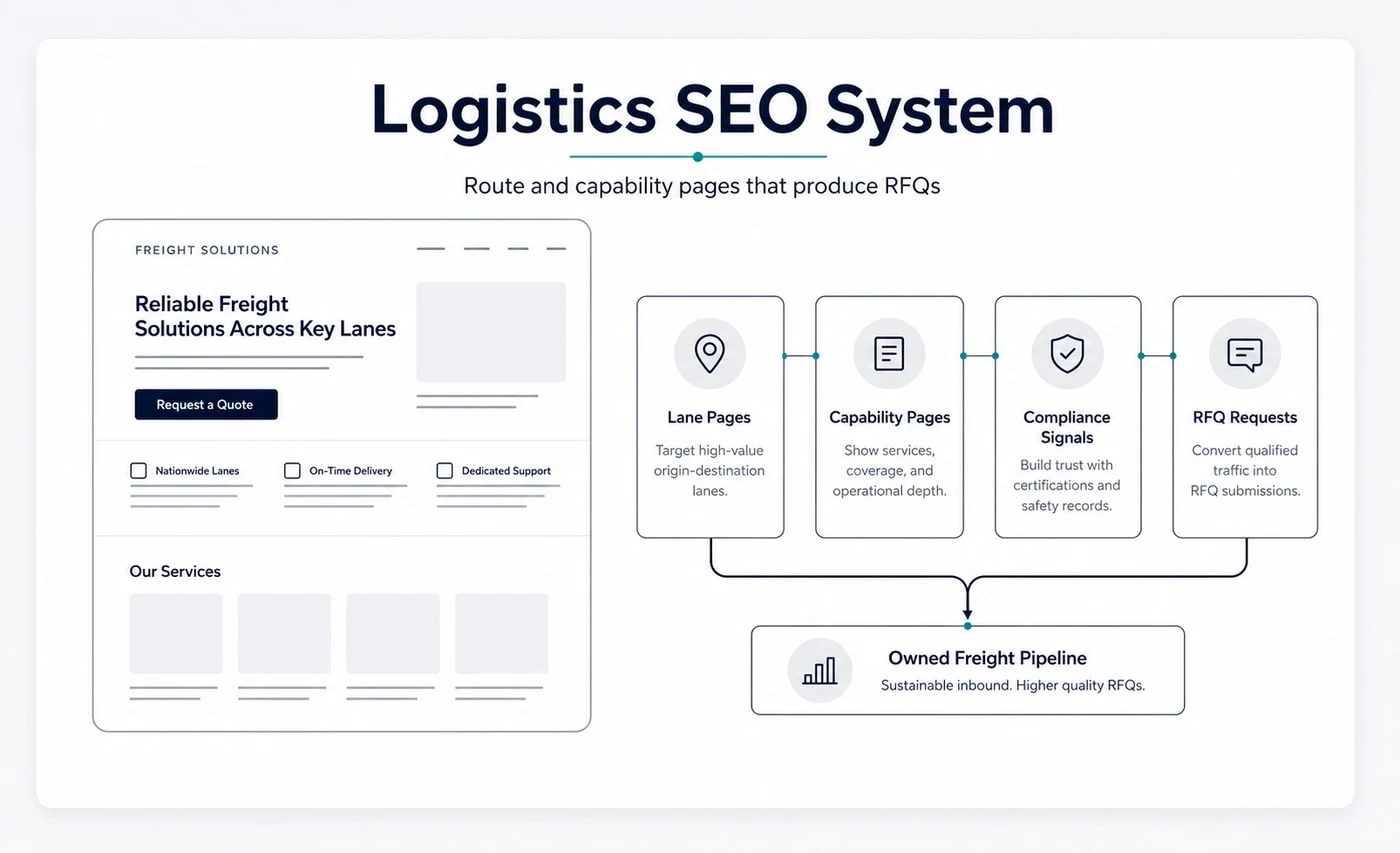
A logistics search system built around lane coverage, capability depth, compliance proof, and RFQ flow.
Most logistics websites have a homepage that lists service categories and a contact form that receives almost nothing. The gap is not traffic. It is capability pages. Procurement managers evaluating freight partners search by operational specifics: lane coverage, certifications, geographic reach, and compliance status. When those pages do not exist, buyers find competitors who built them. A single "3PL Services" page does not rank for "GDP compliant cold chain northeast" or "LTL freight broker Chicago to Atlanta." Those queries require dedicated capability pages built around the exact terminology procurement uses during vendor shortlisting. That is the infrastructure gap every logistics audit finds.
This is not a content calendar or a keyword report. We install organic search infrastructure that generates RFQs and inbound inquiries the way an established freight network generates repeat business: consistently, without depending on per-transaction fees, and compounding as authority grows.
Procurement managers do not search for a logistics company. They search for a specific capability in a specific region with specific credentials. A pharmaceutical shipper searches "GDP compliant cold chain 3PL northeast." A retail buyer searches "LTL freight Chicago to Atlanta same-day pickup." A manufacturer searches "bonded warehouse Los Angeles customs broker." Each of these queries requires its own page, built around the exact terminology buyers use when qualifying vendors for shortlisting. We build that page architecture.
A logistics company operating across multiple states needs each operational hub to rank in local search for the markets it serves. A single "locations" page with a list of addresses earns no authority for any individual market. Each warehouse, distribution center, and depot location needs its own page, its own LocalBusiness schema, and its own Google Business Profile coordination. We build the technical architecture that makes a distributed logistics operation visible in every market it operates, without diluting the authority of the overall domain.
Procurement directors increasingly use AI assistants during early-stage vendor research. When a supply chain manager asks Perplexity which 3PLs handle pharmaceutical cold chain with FDA compliance in the southeast, the AI cites pages with entity-dense content explicitly naming the certifications, the lanes, and the compliance standards. Generic "we handle all types of freight" copy earns no citations. Specific named credentials and capability terminology does. We build the content architecture that earns those citations across ChatGPT, Perplexity, and Google AI Overviews before your competitors do.
A national IT supply chain company generated 500% more inbound organic leads and 210% more ranking keywords in 7 months by rebuilding the site around procurement manager search intent.
A national data infrastructure company grew organic conversions 404%, from 5 per month to 22, by rebuilding commercial pages as a conversion system rather than an information site.
A South-Central US industrial equipment supplier generated 120+ inbound quote requests per month and 410% organic traffic in 7 months by installing commercial page infrastructure on a site that had behaved like a static catalog.

After building search infrastructure for supply chain and logistics companies, the finding is consistent: the capability gap is the core problem, not traffic volume. Procurement managers do not search for a logistics company. They search for a specific capability with specific credentials on a specific lane. When we rebuilt the commercial pages for a national IT supply chain company, the site went from producing inconsistent organic leads to generating 500% more inbound inquiries within 7 months. The buyers were always searching. The pages just did not exist to answer them. That is what the Digital Landlord model looks like in logistics: building the pages that own the queries before competitors do.
A 30 minute call. No pitch deck. We audit your capability page coverage, lane and certification gaps, and multi-location search architecture before any investment is discussed.
Best fit for freight brokers, 3PL operators, warehouse and fulfillment companies, and supply chain technology companies with existing operations but limited organic inquiry volume. Groew does not work with companies that need load board management, carrier relations, or freight rate optimization.