Groew / SEO Services / Content Refresh And Recovery
Content Refresh And Recovery For Compounding Search Value
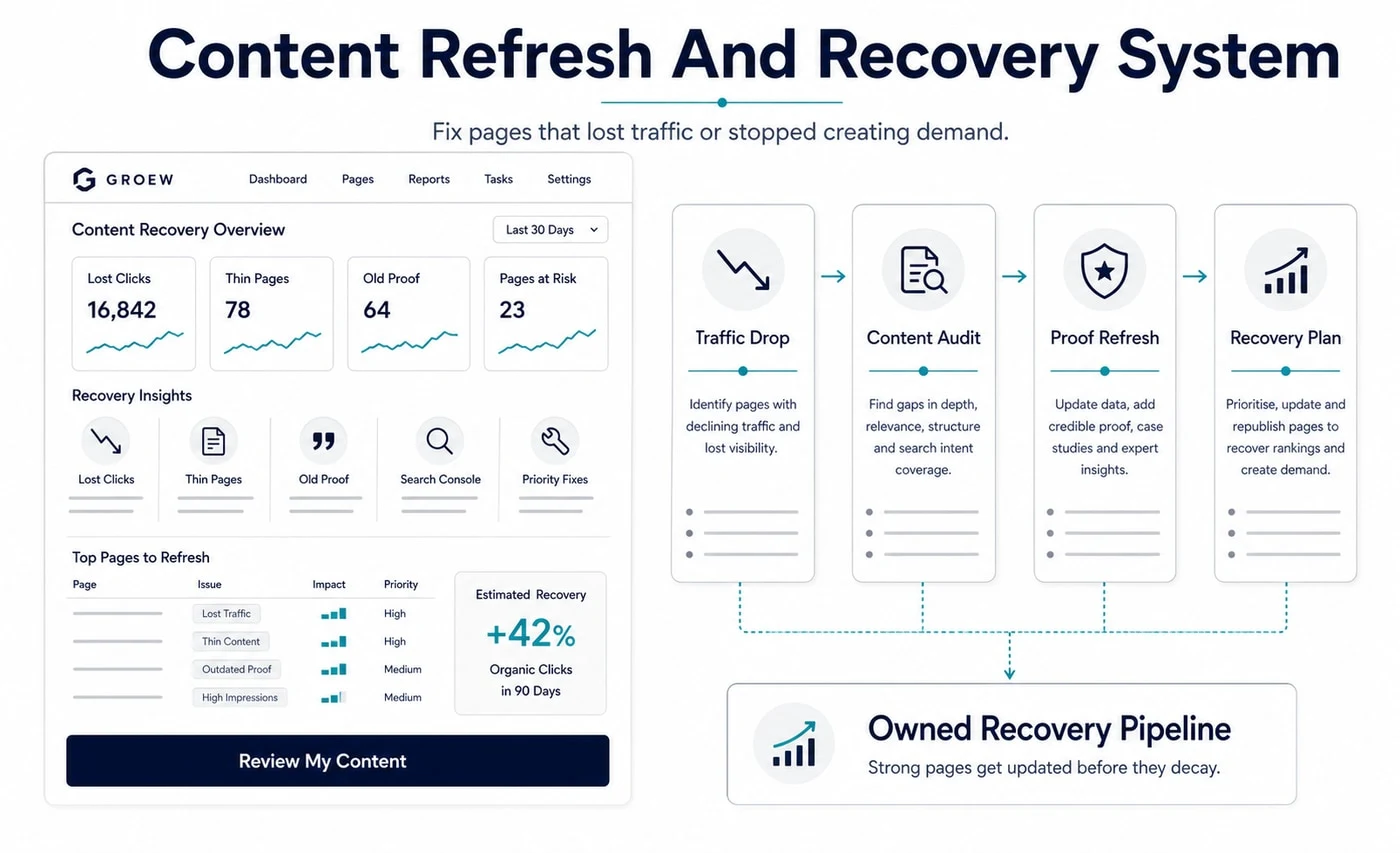
Groew audits declining pages, identifies why rankings dropped and builds a prioritised refresh plan that stops decay, recovers organic value and removes weak patterns before they cost further ground.
A content recovery system built around traffic drop diagnosis, content audit, proof refresh and recovery planning.
What we fix in content refresh and recovery.
Pages that ranked and then dropped
Organic traffic declines that started after a Google update, a competitor publishing stronger content, or the search intent shifting away from what the page answers. The cause is rarely obvious without a structured audit.
Thin content that wastes crawl budget
Short pages with no proof, no specific answers and no clear buyer path. Google deprioritises these over time and they pull down the authority of stronger pages nearby.
Cannibalisation across overlapping topics
Multiple pages competing for the same query without a clear hierarchy. Google cannot decide which one to rank and both stay lower than they should. A merge or redirect usually resolves this faster than rewriting both pages.
Outdated proof that buyers no longer trust
Statistics from three years ago. Client references that are no longer current. Old proof signals weaken trust for both buyers and search engines and give competitors an easy advantage.
What you get.
01
Content audit and triage
Every page categorised: keep as-is, refresh now, merge with another page or remove. Priority ordered by revenue proximity and decline severity so the work starts where it matters most.
02
Refresh plan per page
Specific instructions for each priority page: what proof to update, what structure to fix, what intent gap to close and what to remove. Not a generic content brief.
03
Recovery tracking
Search visibility tracked per refreshed page so the business can see which changes moved rankings and which pages need a second pass before compounding begins.
Alokk's perspective
AlokkFounder and Lead Growth Architect, Groew
The pattern I see most often is a business that published strong content two or three years ago, saw rankings, and then watched traffic slowly drop while new content was being added. The refresh work is almost always faster than the original build. When one data infrastructure client refreshed their commercial pages and fixed cannibalisation across their topic cluster, organic conversions increased 404% over the following 6 months. The pages existed. They just needed the right proof and structure.
Content refresh and recovery questions answered.
Content refresh means updating existing pages with new proof, stronger answers, better structure and current information. The goal is to stop decline, recover rankings and extend the useful life of pages that already have some authority.
Recovery starts with identifying why the page dropped: thin content, outdated proof, cannibalisation, a technical issue or a change in search intent. Groew audits each dropped page before deciding whether to refresh, merge, redirect or remove it.
Commercial pages benefit from a review every 6 to 12 months. Informational pages targeting fast-moving topics need more frequent updates. The priority is always pages closest to revenue that have started to decline.
A refresh updates an existing URL with better proof, structure and answers without changing the canonical address. New content creates a new URL for a query the site does not yet cover. Refreshing is usually faster and carries less risk than starting from scratch.
Poorly planned refreshes can cause temporary fluctuation. Groew audits before making changes, preserves what is working and only changes elements that are measurably weak. Major structural changes are staged, not done in one pass.
From Groew's Search Authority Team
How content refresh and recovery actually works
Most content decline is preventable. Understanding why pages drop makes recovery faster and protects the pages that are still working.
Why content declines over time
Search results are not a permanent record. A page that ranked well 18 months ago faces new competitors, updated search intent and higher quality standards constantly. Google measures whether a page is the best answer available right now, not whether it was the best answer when it was published. Without regular review, even well-written pages lose ground as the category around them improves.
The audit comes before the refresh
A content refresh without an audit is guesswork. The audit answers three questions for every page: why is it declining, what is the search intent now, and what would make this page the clear best answer. Sometimes the answer is updating a statistic. Sometimes it is restructuring the entire page. Sometimes the right answer is to merge two pages or redirect one to a stronger version. The audit decides the right action before any rewriting begins.
Cannibalisation is often the hidden cause
Many businesses find that two or three pages are targeting almost the same query. Google splits its ranking signals across all of them, so none rank as strongly as one consolidated page would. Identifying and resolving cannibalisation is often the fastest path to ranking improvement because it requires no new content: the value already exists and just needs to be consolidated correctly with a redirect or merge.
Proof makes refreshed pages stronger
The most common weakness in declining pages is generic content with no specific proof. Anyone can say a service solves a problem. Fewer can show a specific client outcome, a named observation or a data point with a timeframe. Adding concrete proof to refreshed pages changes how buyers and AI systems evaluate the content. A page that cites a specific outcome is harder for competitors to copy and easier for Google to classify as authoritative.
Recovery connects to Revenue Infrastructure
Content refresh is not just a defensive task. A recovered page that now ranks and converts is part of the Revenue Infrastructure system. Every page that answers a buyer question, builds trust and connects to a clear next step is an owned asset. Refreshing existing pages compounds faster than publishing new ones because the authority is already partially built.
Stop the decline before it becomes permanent.
If pages that used to rank are now invisible or declining, start with a content audit. Groew will show which pages to refresh, which to merge and which to remove.
Get My Free Growth Audit.
No pitch deck. No retainer proposal. An honest read of where your organic growth is blocked and what a 90 day sprint would realistically produce.
Alokk, Founder, Groew
What is your name?
press Enter ↵
What is your email address?
press Enter ↵
Your company website
press Enter ↵
What is your role?
press Enter ↵
Where are you based?
press Enter ↵
What type of business is this?
What are your most important products or services?
Include target verticals and the industries you serve.
Shift + Enter for new line
Are you interested in SEO, AI search visibility, or both?
When are you looking to make a decision?
Estimated monthly budget for SEO, content and links?
All prices in USD. $3,000 USD ≈ £2,400 / AED 11,000.
How did you hear about Groew?
press Enter ↵
Anything else I should know? (optional)
Numbers, timelines, what you have already tried.
Ask AI about Groew
Open Gemini with a guided prompt
Copy the prompt first, open the AI tool next, then paste it into chat to get a grounded answer about Groew.