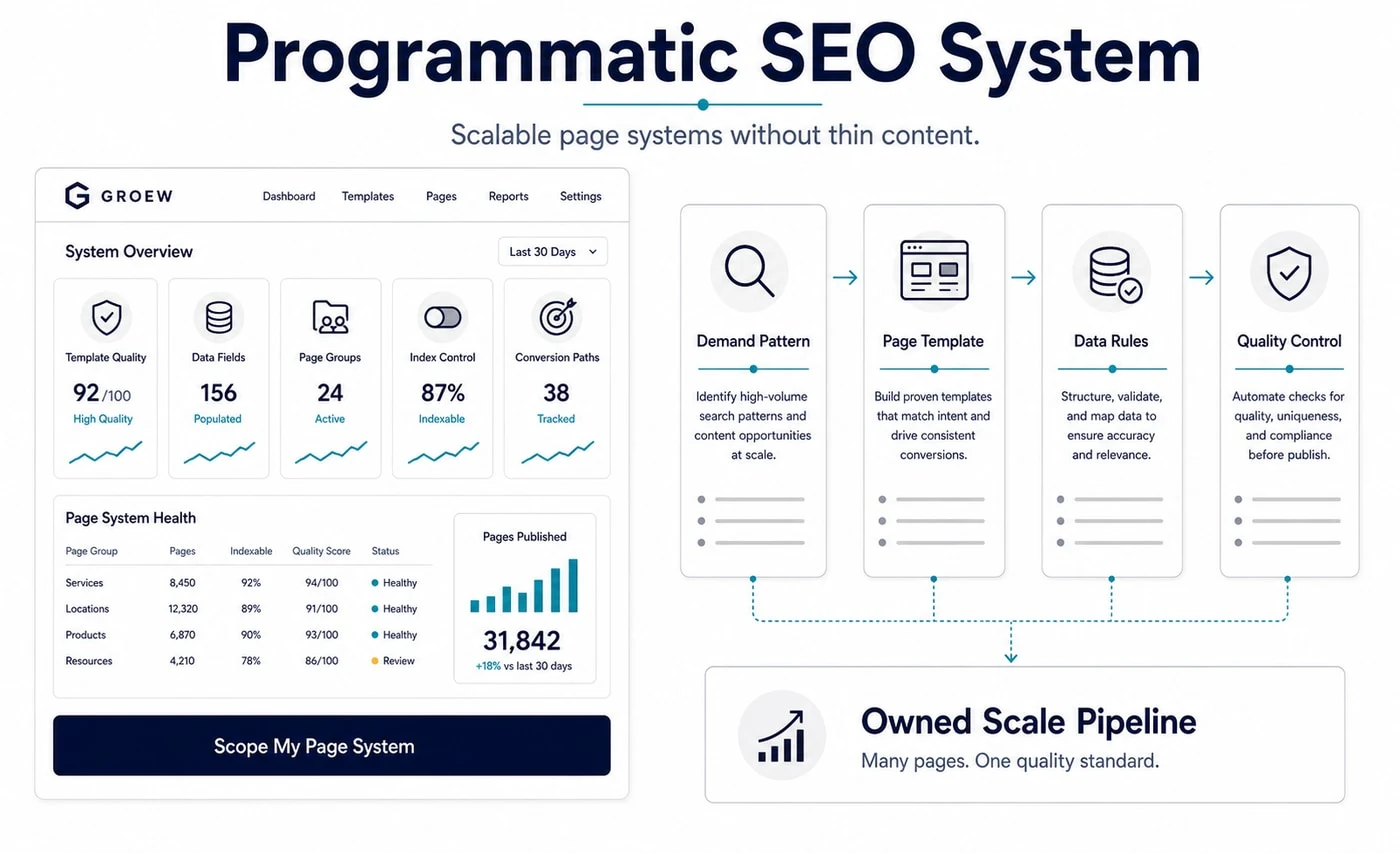
Programmatic SEO For Scalable Page Systems That Compound
Groew builds large sets of pages from a quality template when the demand pattern is repeatable. Locations, integrations, comparisons, categories. Each page earns independently and the system compounds without proportional content effort.
A programmatic SEO system built around demand patterns, page templates, data rules and quality control.
What we fix in programmatic SEO.
Thin auto-generated pages penalised for low quality
Pages that fill a template variable but provide no useful information beyond what the user already knows from the query. Google classifies these as low quality or spam and can penalise the entire domain for hosting them at scale.
No template logic connecting pages to buyer intent
Templates built around data availability rather than buyer questions. A location page that lists an address and a phone number is not an SEO asset. A location page that answers the questions buyers ask about that specific location earns ranking and trust.
Missing internal link structure across large page sets
Hundreds of programmatic pages with no internal links to each other, to the parent category or from the core site. Isolated pages have limited authority and are often under-crawled by Google because there is no clear path to them.
Manually built pages that cannot scale
Service businesses writing individual location or integration pages by hand when the content pattern is largely repeatable. The effort grows linearly with the number of pages and does not compound. A quality template system reduces the effort per page by 80 to 90 percent.
What you get.
01
Demand pattern analysis
Identification of which query sets are repeatable enough to justify a programmatic approach and which are better served by individually crafted pages. Not all high-volume patterns are programmatic opportunities.
02
Page template architecture
Template design with variable fields, fixed quality content blocks, internal link logic and schema implementation. Each template section is mapped to a specific buyer question so no page is thin by design.
03
Quality threshold framework
Rules for which data points must be present for a page to be published. Pages that cannot meet the quality threshold are held back or given a noindex until the data is available. Prevents bulk quality issues before they affect the domain.
Alokk's perspective
AlokkFounder and Lead Growth Architect, Groew
Programmatic SEO works when the quality bar is treated as non-negotiable at every page in the set. The businesses that get penalised are the ones that sacrifice quality for scale: they publish 500 pages where 400 have nothing useful to say. The businesses that compound are the ones that build a template where even the smallest page provides genuinely useful information. Scale earns when every page answers a real question.
Programmatic SEO questions answered.
Programmatic SEO builds large sets of pages from a repeatable template when the same page structure can serve hundreds or thousands of different search queries. It is used for location pages, integration pages, comparison pages, category pages and marketplace listings where the demand pattern is consistent and scalable.
Regular SEO builds individual pages one at a time, each with unique content written for a specific query. Programmatic SEO uses a template with variable fields so one page structure can scale to hundreds of variations. The quality requirement does not change but the delivery method does.
Yes. Programmatic pages that are thin, identical or clearly auto-generated without unique value can trigger a Google spam penalty. The key protection is a quality threshold: every page must provide information a buyer would find genuinely useful, not just fill in a template variable.
Businesses with large, repeatable demand patterns: SaaS platforms with many integrations, marketplaces with many listings, service businesses with multiple locations, comparison platforms, and companies with many product or category variations.
There is no minimum, but programmatic SEO delivers the greatest advantage when more than 50 to 100 similar queries exist and each would benefit from a dedicated page. Smaller sets are usually better served by individually crafted pages with more depth.
From Groew's Search Authority Team
How to build programmatic SEO pages that actually rank
Scale without quality is a penalty waiting to happen. The businesses that compound with programmatic SEO treat the quality threshold as seriously as the scale opportunity.
Identify the repeatable demand pattern first
Not every topic is a programmatic opportunity. The right candidate is a query pattern where the structure of the answer is consistent but the specific entity (location, integration, competitor, category) changes each time. Before building any template, Groew identifies whether the demand pattern genuinely repeats, how many variations exist, and whether each variation represents real buyer intent or just keyword combinations with no actual search audience.
Quality gates prevent domain damage
Every programmatic page template needs a quality gate: a defined minimum set of data points that must be present before the page is published with an index tag. If a location page only has a name and an address, it should not be published as an indexable page. Once a more complete data set is available, the page can be upgraded. Publishing low-quality pages at scale is the fastest way to damage the authority of an otherwise strong domain.
Internal linking multiplies the value of the set
A set of 500 location pages with no internal links to each other, to the parent category page or from the main site navigation is largely invisible to Google. The internal link structure needs to be built into the template itself: each page links to the parent category, to 2 to 3 related pages in the same set, and ideally from a key page higher in the site hierarchy. This structure allows Google to crawl the full set efficiently and pass authority through every page.
Programmatic pages are part of Revenue Infrastructure
A well-built programmatic page system is one of the highest-compounding elements of Revenue Infrastructure. Once the template is built and quality-gated, expanding the system to new locations, new integrations or new comparison topics requires data, not hours of writing. The effort per page drops sharply while the owned search surface keeps growing.
Scale your search surface without scaling your effort.
If the business has a repeatable demand pattern, a quality programmatic page system can multiply owned search visibility without proportional content effort. Start with a pattern analysis.
Get My Free Growth Audit.
No pitch deck. No retainer proposal. An honest read of where your organic growth is blocked and what a 90 day sprint would realistically produce.
Alokk, Founder, Groew
What is your name?
press Enter ↵
What is your email address?
press Enter ↵
Your company website
press Enter ↵
What is your role?
press Enter ↵
Where are you based?
press Enter ↵
What type of business is this?
What are your most important products or services?
Include target verticals and the industries you serve.
Shift + Enter for new line
Are you interested in SEO, AI search visibility, or both?
When are you looking to make a decision?
Estimated monthly budget for SEO, content and links?
All prices in USD. $3,000 USD ≈ £2,400 / AED 11,000.
How did you hear about Groew?
press Enter ↵
Anything else I should know? (optional)
Numbers, timelines, what you have already tried.
Ask AI about Groew
Open Gemini with a guided prompt
Copy the prompt first, open the AI tool next, then paste it into chat to get a grounded answer about Groew.