
Architecting Authority

40% Traffic Drop Reversed. 167% Growth and 111% More MQLs in 12 Months.

Cybersecurity buyers research vendors for months before trusting anyone. Generic SEO misses the compliance coverage pages, trust architecture, and framework-specific content that security buyers require before they will shortlist a vendor.
See how the infrastructure sprint works
3moDecline Stopped
$4.2MARR from Search
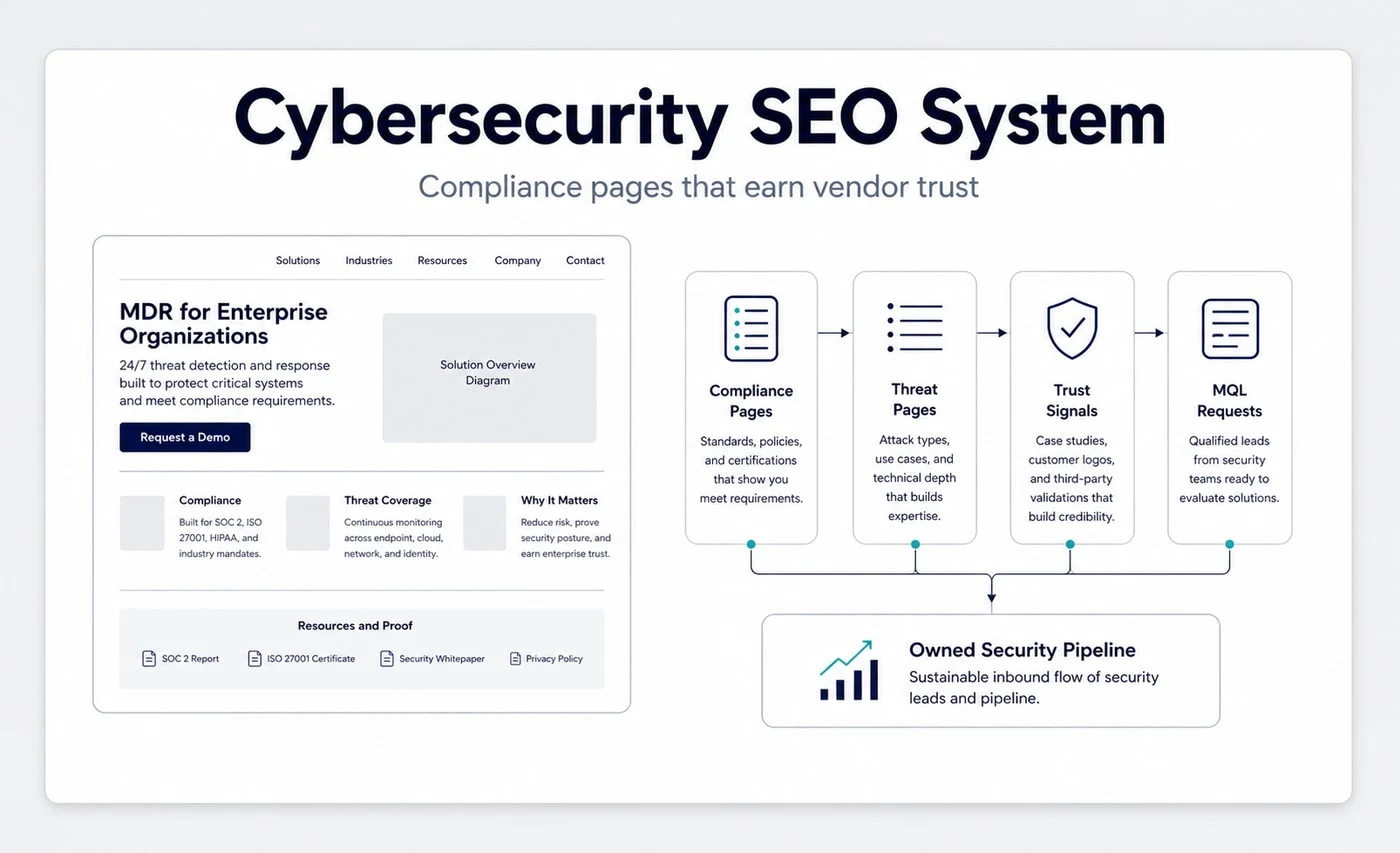
Groew Cybersecurity SEO service visual showing compliance pages, threat pages, trust signals and MQL requests connected to an owned security pipeline.

A cybersecurity search system built around compliance coverage, threat pages, trust proof, and MQL flow.

Why Cybersecurity Companies Lose Organic Ground to Smaller Competitors

Most cybersecurity sites rank for their brand name and nothing else. The compliance pages that enterprise buyers search for during vendor evaluation either do not exist or are buried in a blog archive that Google does not treat as commercial content. The consequence is that CISO-level buyers who are actively evaluating vendors find competitors first. Not because those competitors have a better product. Because their pages answer the compliance query the buyer typed. Organic search in this vertical is not won by volume. It is won by specificity: the page that names the framework, the control category, and the buyer role in one place.

The Commercial Infrastructure We Build for Cybersecurity Companies

This is not a content calendar or a keyword report. We install organic search infrastructure that generates demo requests and MQLs the way a trust-earning sales process does: consistently, by being the right answer when a buyer is actively evaluating compliance solutions.

01

Solution Pages Mapped to Compliance Frameworks and Buyer Roles

A CISO searching for "SOC 2 Type II compliant vendor" needs to land on a page that addresses SOC 2 controls in buyer language, not a generic product page. We build solution pages mapped to the specific compliance frameworks your buyers are auditing against, with separate entry points for CISO, security analyst, and IT director searches. Each page earns the buyer's trust before they reach a form.

02

Technical Foundation That Preserves Rankings Through Every Migration

Cybersecurity companies redesign their sites more frequently than most B2B categories. Each migration without proper redirect preservation destroys the trust signals Google has built over years. We fix the technical foundation before it fails: redirect maps, crawl efficiency, Core Web Vitals, and the E-E-A-T signals that Google uses to evaluate authority in regulated categories.

03

Entity Architecture That Gets You Cited When Buyers Ask AI About Vendors

AI systems cite cybersecurity vendors that clearly define their compliance coverage, supported frameworks, buyer categories, and threat specialisation. When a CISO asks ChatGPT which vendors are compliant with ISO 27001, the answer names the companies whose pages are entity-dense enough for AI extraction. We build the content architecture that puts you in that answer.

Alokk's perspective
Alokk, Founder at Groew
Alokk Founder and Lead Growth Architect, Groew
Every cybersecurity audit I run has the same finding: a 40-page blog archive covering threat trends and a product page that does not rank for a single compliance keyword. The blog talks about vulnerabilities. The product page reads like a datasheet. Meanwhile, the CISO is searching for the specific framework your product covers, and the page does not name it once. When we rebuilt the commercial pages for a cybersecurity SaaS that had lost 40% of its organic traffic, MQLs grew 111% in 12 months. Security buyers trust one vendor deeply, and that trust starts with whether your page answers their compliance question before they need to ask it. That is a Revenue Infrastructure problem, not a content volume problem.

Cybersecurity SEO Questions

For cybersecurity companies, first measurable gains typically appear in 60 to 90 days once the commercial page architecture is in place. A cybersecurity SaaS that had lost 40% of organic traffic saw that decline stop within 3 months and achieved 167% growth over 12 months. Timeline depends on how competitive your compliance and solution keywords are and how much remediation the current site requires.
Cybersecurity buyers research under compliance pressure and reputational risk. They search by compliance framework, threat type, and vendor trust signal, not by generic service names. A CISO searching for SOC 2 compliance tools expects to see SOC 2 controls discussed on the page. Generic keyword research misses all of it. Organic search infrastructure for this vertical requires deep understanding of how each buyer role evaluates vendors.
Yes. AI systems cite cybersecurity vendors that clearly define their compliance coverage, supported frameworks, buyer categories, and threat specialisation. Pages with FAQ schema are cited at three times the rate of plain prose pages. Entity-dense content that names the specific standards you address gets cited more frequently. Use the AI brand visibility checker to test whether your cybersecurity business appears in AI recommendations today.
Engagements start from a defined sprint fee, not an open-ended monthly retainer. Everything delivered belongs to you permanently. There is no ongoing payment required to keep the infrastructure running. The best first step is a where we diagnose exactly what is blocking your MQL and demo pipeline from organic search before any investment is discussed.
Ask whether they understand the difference between how a CISO searches and how an IT director searches. Ask whether they can name the compliance frameworks your buyers care about. Ask for proof from cybersecurity or regulated B2B verticals specifically. Generic B2B SEO experience is not the same as understanding the trust architecture that security buyers require before shortlisting a vendor.
Build dedicated solution pages that address each compliance framework from the buyer perspective. A SOC 2 page that answers what SOC 2 means for a buyer evaluating vendors, what evidence to ask for, and how your product addresses each control category will outrank a page that just says you are SOC 2 compliant. Depth, specificity, and buyer framing separate ranking pages from invisible ones. See our topical authority checker to see where your compliance coverage has gaps.
Site migrations without redirect preservation are the most common cause of sudden traffic drops for cybersecurity companies. When URLs change or page content is rewritten without preserving ranking signals, the trust Google built for those pages disappears. One cybersecurity SaaS lost 40% of organic traffic after a redesign. Preserving redirect maps, page hierarchy, and on-page entity signals during any migration is critical.
Over-gating is one of the most common SEO problems for cybersecurity companies. When technical content is hidden behind a form, Google cannot index it and buyers cannot find it before contacting you. The solution is not to remove gates entirely but to make the landing pages for gated content genuinely indexable, with enough entity-dense visible text to rank for the queries the content addresses.
From Groew's Search Authority Team

What We Find When We Audit Cybersecurity Sites, and What We Fix First

The gap is the same across every cybersecurity audit we run. Compliance coverage exists in sales decks but not on the pages buyers find in search. AI tools are shifting how security buyers discover vendors. The companies that name their frameworks clearly in indexable content are getting shortlisted before outreach begins.

What the Audit Reveals on Every Cybersecurity Website

The first thing we find on every cybersecurity site is a product page that claims enterprise-grade security without naming the specific frameworks that claim applies to. The CISO shortlisting vendors for a SOC 2 audit is not reading "enterprise-grade security." They are searching for "SOC 2 Type II compliant endpoint security vendors" and clicking the pages that name the control categories they need to verify. When we rebuilt the commercial pages for a cybersecurity SaaS that had lost 40% of its organic traffic, the primary fix was mapping each solution page to the specific compliance frameworks buyers were searching for. MQLs grew 111% in 12 months.

Read the complete guide

Why Compliance Coverage Pages Are Your Most Important Commercial Asset

Cybersecurity buyers evaluate vendors by their coverage of specific regulatory frameworks before they evaluate product features. A CISO at a healthcare organization is searching for HIPAA-compliant vendors. A procurement team at a federal contractor is searching for FedRAMP-authorized solutions. A financial services IT director is searching for vendors that can document SOC 2 Type II audit results. These are commercial-intent queries with high conversion probability, and they can only be captured by pages that name the frameworks explicitly in the title, headings, and body content. A generic "security solutions" page will not rank for any of them. Building dedicated compliance coverage pages for each framework your product addresses is the highest-return investment a cybersecurity company can make in organic search.

How Cybersecurity Buyers Research Vendors Before Contacting Anyone

Security buyers conduct longer and more structured research than almost any other B2B category. A typical cybersecurity purchase involves a CISO setting requirements, a security analyst conducting technical evaluation, and an IT director or procurement team handling vendor qualification. Each role searches at a different stage with different language. CISOs search by compliance framework and business risk. Security analysts search by threat vector, integration capability, and technical specification. IT directors search by vendor reviews on G2, pricing models, and contract terms. A single product page cannot serve all three. The companies that build separate entry points for each buyer role, each mapped to the specific questions that role asks in search, are the ones that appear across the full evaluation journey. By the time a buyer reaches a form, they have already decided you are credible. That is what reduces time to demo and increases MQL quality.

Why Site Migrations Kill Cybersecurity Rankings and How to Prevent It

The most common cause of sudden, unexplained traffic drops for cybersecurity companies is a site redesign or platform migration handled without SEO preservation. When URL structures change, redirects are missing or incorrect, page content is rewritten without preserving the entity signals Google indexed, or authority flows are disrupted by new navigation structures, the trust Google had built for those pages resets. One cybersecurity SaaS we worked with had lost 40% of organic traffic over 11 months following a redesign. The decline ran for nearly a year before the root cause was identified and the remediation began. Stopping the decline took 3 months. Rebuilding to 167% growth took 12 months. The cost of a migration done without SEO preservation is measured in years of compounding authority, not just short-term traffic. Every migration should begin with a full redirect map, entity preservation audit, and crawl health check before a single page is published.

The Revenue Infrastructure Model for Cybersecurity Companies

The cybersecurity market is one of the highest-trust, highest-scrutiny B2B categories in existence. Buyers do not make rushed decisions. They research vendors for months, cross-reference claims against audit results, and check reviews on independent platforms before any conversation begins. The companies that own the organic search landscape in this market have built an infrastructure that meets buyers at every stage of that research process, from the first compliance framework query to the final vendor comparison. This is what Revenue Infrastructure means for cybersecurity companies: not more blog posts, but the right commercial pages, the right trust signals, and the right entity density to be the answer that buyers find and trust before anyone makes a call. The cybersecurity companies that invest in this infrastructure compound their authority over time. Those that rely on paid acquisition see CAC rise as competition for the same ad inventory intensifies. Organic infrastructure does not reset when the budget does.

Find Out What Your Cybersecurity Site Is Missing

A 30 minute call. No pitch deck. We diagnose which compliance keywords you are invisible for, which buyer roles your pages are not serving, and what the highest-return fix is before any investment is discussed.

Best fit for cybersecurity SaaS companies, MSSPs, penetration testing firms, and compliance consultancies with an existing site and a defined compliance coverage set. If organic search is not part of your current growth thinking, we are not the right fit.

ESC