
Architecting Authority
Architecting Authority
Managed IT buyers search by problem, not by service name. They search for what broke, what slowed down, and who can fix it in their market. Generic SEO targets the service name and misses every buyer who is actively searching for help.
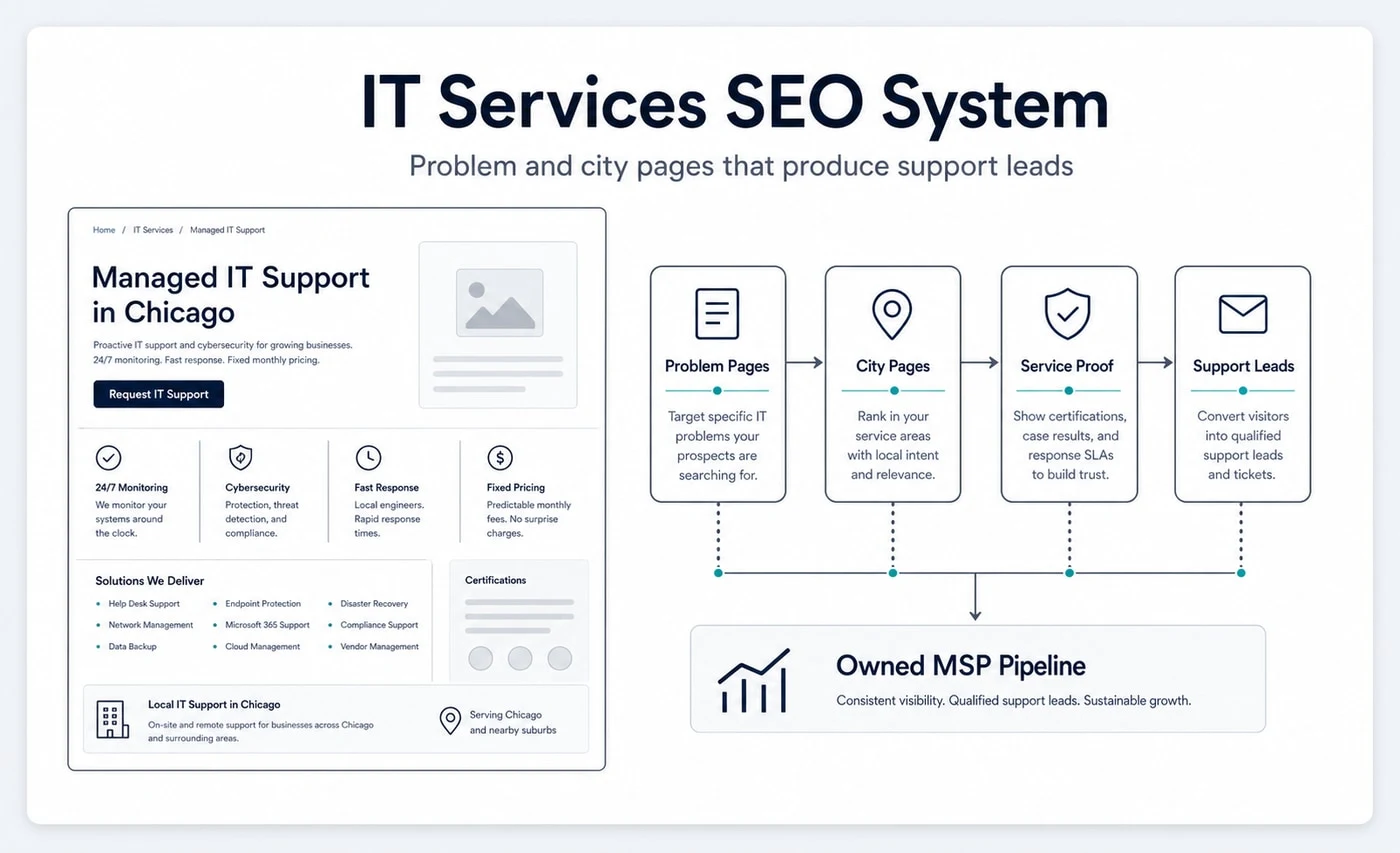
An MSP search system built around problem pages, city visibility, service proof, and qualified support leads.
IT services SEO differs from generic B2B SEO because managed IT buyers search by problem, not by service category. IT directors searching for outsourced IT partners, business owners searching for IT support pricing, and operations managers evaluating cloud migration vendors all use different language. Organic search infrastructure for this vertical must match service pages to the specific problems buyers type at the moment they need help. When we rebuilt the commercial pages for an East Coast managed IT services provider, organic leads averaged 8 per month over 16 months, with first gains arriving in under 90 days.
This is not a blog publishing plan or a keyword spreadsheet. We install organic search infrastructure that generates qualified IT leads the way a trusted referral network does: consistently, from buyers who already understand what you do before they call.
Buyers searching for IT help describe the problem, not the service. "Ransomware protection for small business," "HIPAA compliant IT support," "cloud migration for law firms," "managed helpdesk pricing." We rebuild your service pages around this language, so the buyer who is actively searching for what you do finds a page that speaks directly to their situation. Bounce rate drops. Leads arrive.
The highest-converting IT support searches include a city or "near me" modifier. An SMB owner searching for IT help in their city is a buyer with an active need, not a researcher. We build genuine city-specific service pages for every geographic market you serve, strengthen your Maps presence with the authority signals Google uses to rank local results, and create the internal linking structure that flows authority from your strongest pages into your city pages.
When a business owner asks ChatGPT for managed IT providers in their city, AI systems cite the MSPs whose pages clearly define their service territory, supported industries, compliance coverage, and response commitments. Vague "we handle all your IT needs" language gets ignored. Specific entity-dense content about your exact capabilities and client types gets cited. We build the content structure that puts your MSP in that answer.
An East Coast managed IT services provider averaged 8 qualified organic leads per month over 16 months.
A US-based IT supply chain SaaS company grew inbound organic leads 500% and ranking keywords 210% in 7 months.
A national data infrastructure company grew organic conversions 404% by fixing commercial page architecture in 18 months.

Every MSP audit has the same finding: the homepage says "managed IT services" and the service pages say "proactive monitoring" and "helpdesk support." Their buyers are searching for "IT company for law firms near me" and "managed services pricing Houston." None of those pages exist. When we rebuilt the commercial pages for a managed IT provider on the East Coast, they went from almost no organic leads to 8 per month consistently, with the first gains arriving in under 90 days. MSPs have some of the highest local search intent of any B2B category. Buyers are actively looking when they search. The infrastructure just has to be there. That is what Revenue Infrastructure means for IT services: the right pages, in the right markets, built for the right buyers.
A 30 minute call. No pitch deck. We diagnose which problem-language keywords you are invisible for, which buyer types your pages are not serving, and what the highest-return fix is before any investment is discussed.
Best fit for managed IT providers, MSSPs, IT support companies, and cloud services firms with an existing website and at least one defined service territory. Groew does not work with IT staffing companies, freelance technicians, or companies that need social media management before any search work makes sense.