Architecting Authority

International SEO That Builds Market Structure Across Regions

Groew builds country, language and market page structure for businesses expanding to multiple regions, so each market gets the right content without duplicate signals splitting authority or confusing Google.

See What Gets Fixed
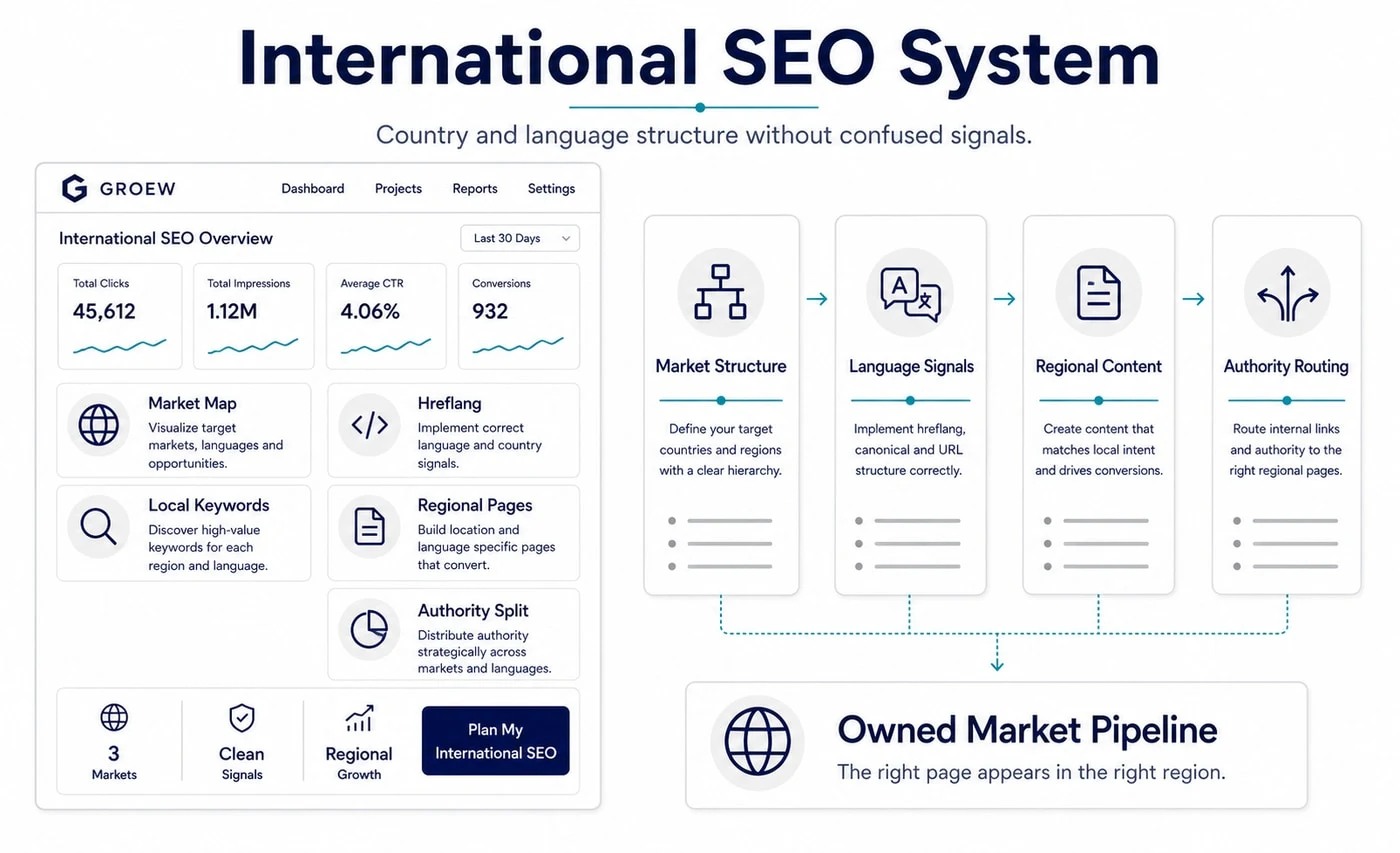
Groew International SEO service visual showing market structure, language signals, regional content and authority routing connected to an owned market pipeline.

An international SEO system built around market structure, language signals, regional content and authority routing.

What we fix in international SEO.

Duplicate content across country versions

Multiple country pages with near-identical content and no clear hreflang signal. Google treats them as duplicates and may suppress all versions rather than ranking the correct one in each market.

Hreflang tags missing or incorrectly configured

Missing hreflang, self-referencing errors, language codes without country codes, or return tags that break the hreflang loop. All of these cause Google to ignore the international structure entirely and serve the wrong page to the wrong market.

No market-specific commercial page architecture

One service page translated into five languages with no adaptation to local buyer language, local proof or local search intent. Direct translation rarely matches how buyers in a different market search for the same problem.

Authority split across domains without strategy

Separate country domains with no cross-domain link strategy or shared authority signals. Each domain builds slowly from scratch instead of benefiting from the authority of the primary domain.

What you get.

01

International architecture audit

Assessment of current URL structure, hreflang implementation, canonical signals and which markets are being served correctly versus which are suppressed or cannibalised.

02

Hreflang and structure plan

Complete hreflang implementation plan with URL structure recommendation, canonical logic per market and sitemap instructions so every market version is correctly indexed and served.

03

Market content strategy

Per-market keyword and intent mapping so commercial pages are adapted to local buyer language, not just translated. Covers which pages to localise first by revenue priority.

Alokk's perspective
Alokk, Founder at Groew
Alokk Founder and Lead Growth Architect, Groew
The most common international SEO problem is not a technical one. It is a content architecture problem. Businesses translate their homepage and three service pages and expect ranking movement in five markets. The markets that compound fastest are the ones where the commercial pages are adapted to how buyers in that region describe the problem, not just translated word-for-word from the English version. Technical signals matter, but intent-matched content is what actually ranks in a new market.

International SEO questions answered.

International SEO builds the site architecture, language signals and regional page structure that helps Google serve the right version of your content to the right country or language audience. It covers hreflang tags, country-specific URLs, regional content and multi-market keyword strategy.
Hreflang tags tell Google which language and country a page targets and which pages are equivalent versions of each other. Incorrect or missing hreflang tags cause Google to serve the wrong page version to users, split ranking signals across duplicates and suppress visibility in target markets.
Subdirectories (e.g. groew.com/uk/) are generally easier to manage because they inherit root domain authority. Country-code top-level domains (e.g. groew.co.uk) send the strongest geo-targeting signal but require building authority independently. Groew selects the right structure based on the specific market and business goals.
Translation alone rarely produces strong international rankings. The content must also match local search intent, use market-specific proof and answer questions the way buyers in that region actually ask them. Direct translation of existing pages typically produces weaker results than market-adapted content.
International SEO typically takes 3 to 6 months to show measurable ranking movement in a new market. The timeline depends on the authority of the existing domain, the competitiveness of the target market and how well the technical signals and content are structured.
From Groew's Search Authority Team

How international SEO works across multiple markets

Expanding to new markets is not a copy-and-translate task. Each market needs its own signals, structure and content decisions to rank independently.

Structure is the first decision

Before writing a single word of international content, the URL structure must be decided. Subdirectories, subdomains and ccTLDs each carry different authority inheritance and geo-targeting strength. The right choice depends on how much authority the root domain already has, whether the business needs to appear locally credible in a specific country, and how much development resource is available to maintain separate properties over time.

Read the complete guide

Hreflang implementation is frequently broken

Hreflang is one of the most commonly misconfigured elements in international SEO. The most frequent errors are missing return tags (every page must reference all other language versions of itself), incorrect language codes (en vs en-gb vs en-us), and hreflang loops broken by redirects or canonicals that override the signals. A single misconfigured hreflang tag can suppress an entire country version from Google's consideration.

Local buyer language is different from translated copy

Buyers in the UK describe problems differently from buyers in the US. Buyers in Germany research in patterns different from buyers in France. A service that helps companies reduce customer acquisition cost might be searched as "lower CAC" in the US and "reduce cost per acquisition" in the UK. These differences matter when the search volume is split across multiple phrases and the commercial pages need to match the exact language buyers use before they contact a vendor.

International SEO connects to Revenue Infrastructure

Building international search visibility is not just a traffic task. Each market where the business ranks for commercial queries is an additional owned growth channel in the Revenue Infrastructure. A business that ranks in three markets owns three compounding lead sources that do not reset when a campaign ends or a budget is cut.

Build search visibility in every market you serve.

If the business operates across multiple countries or languages, a structured international SEO plan prevents authority from being split and ensures each market gets the right signals.

ESC