
Architecting Authority

$4.2M in ARR From Search Alone. 847% More Organic Demos in 18 Months.

SaaS SEO fails when solution pages are built for engineers instead of buyers. G2 and Capterra intercept commercial intent while your content brings researchers with no purchase intent.
See how the infrastructure sprint works
67%CAC Reduction
500%More Organic Leads
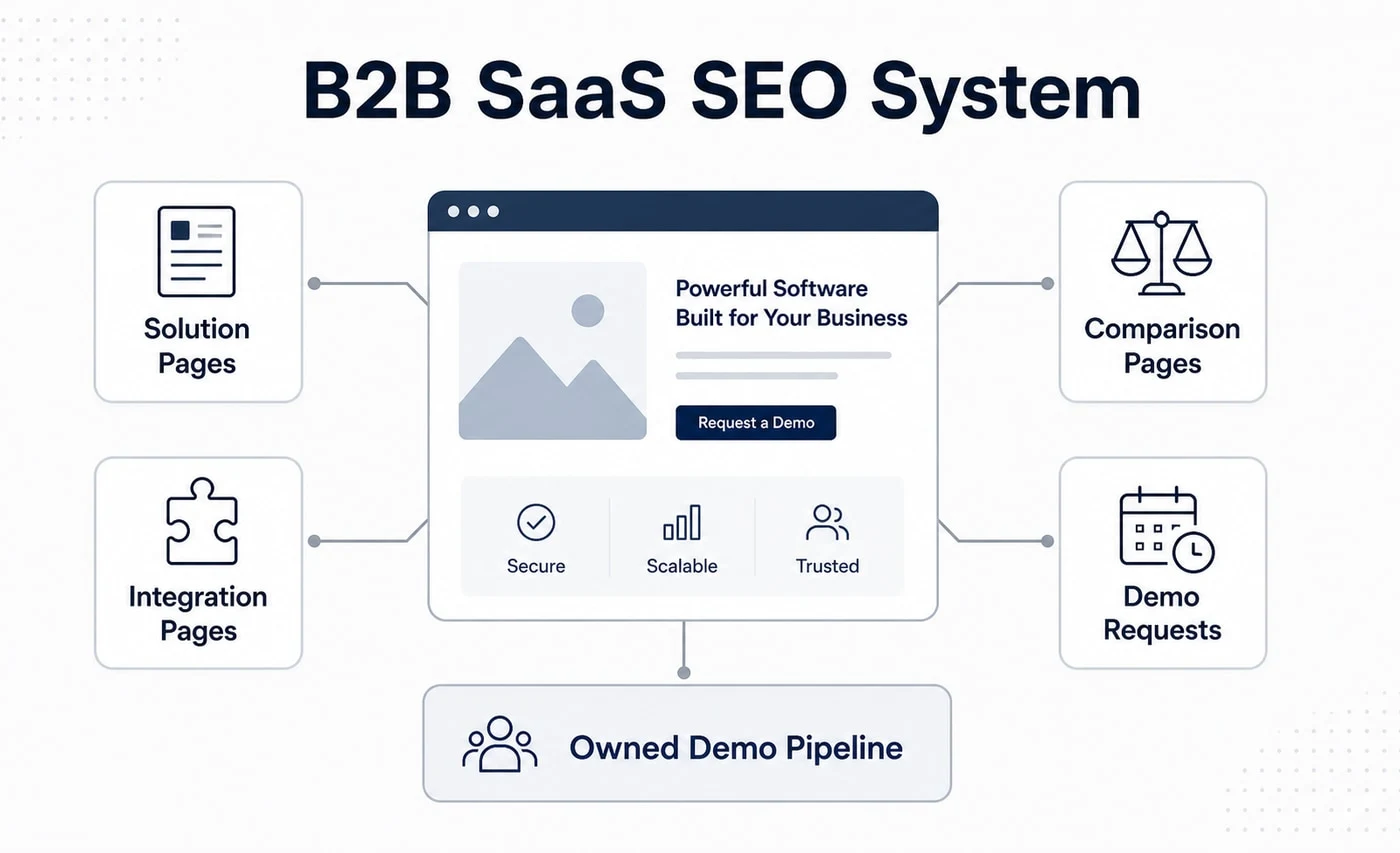
Groew B2B SaaS SEO service visual showing solution pages, comparison pages, integration pages and demo requests connected to an owned demo pipeline.

The commercial page infrastructure that turns category searches into demo requests, without depending on paid channels.

Why B2B SaaS Sites Rank But Don't Generate Demos

When we audit a B2B SaaS site, the finding is the same regardless of product category: the buyer is not searching for the product name, and no pages exist for what they are actually searching. A VP of Engineering searches for SOC 2 Type II compliant integrations. A Head of Revenue Operations searches by workflow failure. A founder evaluating spend searches by CAC outcome. Each query requires a different page, different entity vocabulary, and a different conversion path. When those pages do not exist, organic search infrastructure sends traffic to G2 and Capterra instead of a demo form. When we rebuilt the commercial pages for a US data security SaaS company, they went from zero organic demos to $4.2M in ARR from search in 18 months.

The consequence is that CAC stays permanently elevated. Paid channels carry the full acquisition load. Every demo generated by ads resets when the budget pauses. The commercial page gap is not a content problem. It is a system problem. The fix is not more blog posts.

The Commercial Infrastructure We Build for B2B SaaS

This is not a content calendar or a keyword report. We install organic search infrastructure that generates demo requests the way a well-built product generates retention: consistently, without depending on paid channels, and compounding as authority grows.

01

Solution Pages That Convert Category-Aware Buyers Into Demo Requests

Most SaaS sites have dozens of blog posts and fewer than five solution pages. The ratio is inverted. Blog posts attract researchers. Solution pages convert buyers. A VP of Engineering evaluating a purchase does not need more thought leadership. They need a page that answers their specific technical and compliance questions, shows integration compatibility, and makes requesting a demo the obvious next step. We build the solution pages, use-case pages, and comparison pages that exist at the exact point buyers are making decisions.

02

Site Architecture Built for Multi-Product SaaS Crawlability and Trust

SaaS sites generate technical debt that undermines search performance: staging environments indexed by accident, documentation subdomains diluting authority, free-trial pages competing with commercial pages, and changelog content consuming crawl budget. Simultaneously, enterprise SaaS buyers conduct security reviews that include checking Google for SOC 2 compliance signals and GDPR data handling documentation. We fix the architecture that blocks rankings and install the trust signals that move enterprise procurement past the security review stage.

03

Appearing in ChatGPT and Perplexity When Buyers Research Your Category

SaaS buyers increasingly ask AI assistants which tools solve their problem before opening G2 or Google. When a buyer asks ChatGPT which platforms offer SOC 2 compliant project management, or which CRM integrates with HubSpot and meets GDPR requirements, the AI cites pages with entity-dense, structured content. Generic "we offer comprehensive features" copy earns no citations. Named integrations, named certifications, and problem-first structure do. We build the content architecture that earns those citations across ChatGPT, Perplexity, and Google AI Overviews.

Alokk's perspective
Alokk, Founder at Groew
Alokk Founder and Lead Growth Architect, Groew
After building search infrastructure for B2B SaaS companies, the pattern is consistent: the commercial intent gap is the main blocker, not content volume. When we diagnosed a US data security SaaS company, their solution pages were written for engineers evaluating technical specifications, not for buyers evaluating ROI and security compliance. Within 18 months of rebuilding those pages around buyer-intent queries, the company was generating $4.2M in ARR from organic search and CAC had dropped 67%. That outcome is what the Digital Landlord model looks like for SaaS: an asset that compounds without resetting when spend stops.

B2B SaaS SEO Questions

Solution page rebuilds and commercial intent fixes typically improve demo request volume within 60 to 90 days. Ranking movement for competitive SaaS category queries takes 4 to 8 months depending on domain authority and keyword difficulty. For one US data security SaaS company, organic produced zero demos before infrastructure was installed. Within 18 months, organic was generating $4.2M in ARR with a 67% lower CAC than paid channels.
The fundamental difference is buyer search behaviour. SaaS buyers do not search for a product name. They search by problem: how to reduce churn, managed billing for SaaS, SOC 2 compliant CRM. Generic SEO targets broad categories. SaaS SEO maps solution pages to the exact queries buyers use during evaluation. The conversion goal is also specific: a demo request or free trial signup, not a generic contact form completion.
You do not compete with G2 on review aggregation queries. You compete on the queries buyers use before checking G2: solution-specific searches, integration searches, competitor comparison searches, and problem-definition searches. A well-built solution page targeting a specific buyer problem outranks a G2 category page for that intent. Groew builds the pages that capture buyers before they reach the aggregator shortlisting stage.
Product and solution pages first. Always. Blog content attracts researchers. Solution pages convert buyers. Most SaaS sites have the wrong ratio: 40 blog posts and 3 thin product pages. The pages that generate demo requests are solution pages built around buyer evaluation queries. Once commercial pages are producing demos, blog content that links back to those pages amplifies authority. The reverse order produces traffic that never converts.
Yes. When a buyer asks ChatGPT which tools solve a specific problem, the AI cites pages with structured, entity-dense content naming the problem, the solution, the integration ecosystem, and compliance certifications such as SOC 2 Type II and GDPR. Generic product descriptions do not earn citations. Groew builds FAQPage schema, named entity optimization, and problem-first content blocks that position your product as the cited answer in AI category searches. Use the AI brand visibility checker to test whether your SaaS product appears in AI recommendations today.
The most common cause is content-to-conversion misalignment. Awareness content brings visitors who are not evaluating a purchase. Without solution pages that match buying-intent queries, traffic accumulates but demo requests do not. The second cause is commercial page weakness: solution pages that describe the product instead of answering the buyer's problem. Content volume is not the issue. Commercial page quality and intent alignment are. Use the topical authority checker to see which buyer-intent topics your site currently covers.
Groew's infrastructure sprint starts at $3,000 USD per month. SaaS engagements vary based on the number of solution pages that need rebuilding, the product complexity, and whether index contamination from staging or docs environments requires immediate resolution. There is no open-ended retainer. The best first step is a where we diagnose the commercial intent gap before any investment is discussed.
Yes, in one specific way. Buyers now ask AI assistants which tools solve their problem before searching Google or checking G2. The AI cites pages with structured, named-entity content describing the problem, the solution approach, and compliance certifications. SaaS companies that build problem-first solution pages with FAQPage schema appear in AI recommendations. Those that publish awareness blog posts do not. The infrastructure required to rank in Google and earn AI citations is the same.
From Groew's Search Authority Team

What We Find When We Audit a B2B SaaS Site, and What Gets Fixed First

B2B SaaS companies publish more content than any other B2B category. They also generate among the lowest organic-to-demo conversion rates. When we audit a SaaS site, the gap is not content volume. It is the absence of commercial pages built around specific buyer problems. The sites that compound organic demo pipelines are built differently from the ones that accumulate traffic without pipeline. Here is what the audit reveals.

The Commercial Intent Gap: What Most SaaS Sites Are Missing

The blog has dozens of posts. The product page has three paragraphs. Solution pages for specific use cases, buyer segments, and integration scenarios do not exist. The organic traffic that does arrive lands on content pages with no path to a demo. When we map the keyword landscape for a SaaS site, the evaluation-stage queries are almost always uncontested: "CRM with HubSpot integration for healthcare" or "SOC 2 compliant project management for remote teams." G2 and Capterra do not rank for these. A well-built solution page does. Story 3 saw 847% more organic demos and $4.2M in ARR from search after commercial page infrastructure was built alongside the existing content. The blog was not the problem. The missing solution pages were.

Read the complete guide

The Solution Page Architecture That Converts SaaS Buyers

A solution page built for conversion has four elements that most SaaS pages omit. First, the headline answers the buyer's problem, not the product's name. "Reduce IT supply chain delays with automated vendor tracking" converts. "[Product Name] Supply Chain Module" does not. Second, the page names the specific buyer role and their specific outcome goal. A VP of Operations has different concerns from a CTO. The page should address the right person's concerns explicitly. Third, compliance and integration signals appear above the fold. SOC 2 Type II, GDPR compliance, Salesforce integration, HubSpot compatibility. These are not footnotes. They are the trust signals enterprise buyers require before scheduling a demo. Fourth, the conversion path is low-friction. A single CTA, visible without scrolling, that offers a demo or a specific outcome. When one US data security SaaS rebuilt its solution pages around these four elements, organic demo requests grew 847% over 18 months and the site generated $4.2M in ARR from search without changing its paid acquisition budget.

How to Get Cited in ChatGPT When Buyers Research Your Category

When a B2B buyer asks ChatGPT which platforms offer SOC 2 compliant workflow automation for mid-market companies, the AI does not search G2. It cites the pages in its training data and retrieval index that most directly answer the question with named, structured content. Pages that name the specific certifications, the specific integrations, the specific buyer type, and the specific problem outcome are cited. Pages with generic feature lists and marketing copy are not. The content architecture that earns AI citations is identical to the content architecture that ranks in Google: entity-dense, problem-first, structured with FAQPage schema, and written for the specific buyer's evaluation question.

Why Awareness Content Fails SaaS CAC Goals

The SaaS content playbook from 2018 has not adapted to 2026 search behaviour. The assumption was: publish educational content, attract organic traffic, nurture visitors into prospects. This produces diminishing returns now that buyers begin on Google, AI assistants, and G2, often with specific evaluation questions already formed. The content that should be funded first is the content that exists at the evaluation stage: solution pages, comparison pages, integration pages, pricing pages, and FAQ content that answers due diligence questions. Companies that invert this priority generate traffic without demos. The traffic number grows. The CAC stays high. A national data infrastructure company came to Groew with 1,250 monthly visits and five organic conversions per month. After rebuilding commercial pages around conversion intent, organic conversions grew 404% in 18 months. The fix is not more content. It is the right content in the right order.

Revenue Infrastructure vs Content Marketing: The Compounding Difference

Content marketing is an expense. It requires continuous output to maintain visibility. Stop publishing and the benefit decays. Revenue Infrastructure is an asset. A well-built solution page keeps ranking, keeps attracting buyers, and keeps generating demo requests whether you publish anything new that month or not. The distinction matters for CAC calculation. When acquisition cost is measured against an asset that compounds over time, the cost per demo falls with each passing quarter. The infrastructure sprint does not produce a content calendar. It produces permanent commercial pages that work without maintenance.

Find Out What Your B2B SaaS Site Is Missing

A 30 minute call. No pitch deck. We audit your solution pages, commercial intent gaps, and AI citation readiness before any investment is discussed.

Best fit for B2B SaaS companies with existing traffic that is not converting to demo requests, and businesses where CAC from paid channels is rising and organic is not contributing pipeline.

ESC