
Architecting Authority

$17.5M in New Investor Capital Attributed to Organic Growth.

Most financial services firms have offline credibility their website does not reflect. Investors search, land on generic pages, and self-disqualify silently. We install trust architecture that converts organic visibility into investor inquiries.
See how the infrastructure sprint works
8x Conversion Growth
4.00% Conversion Rate
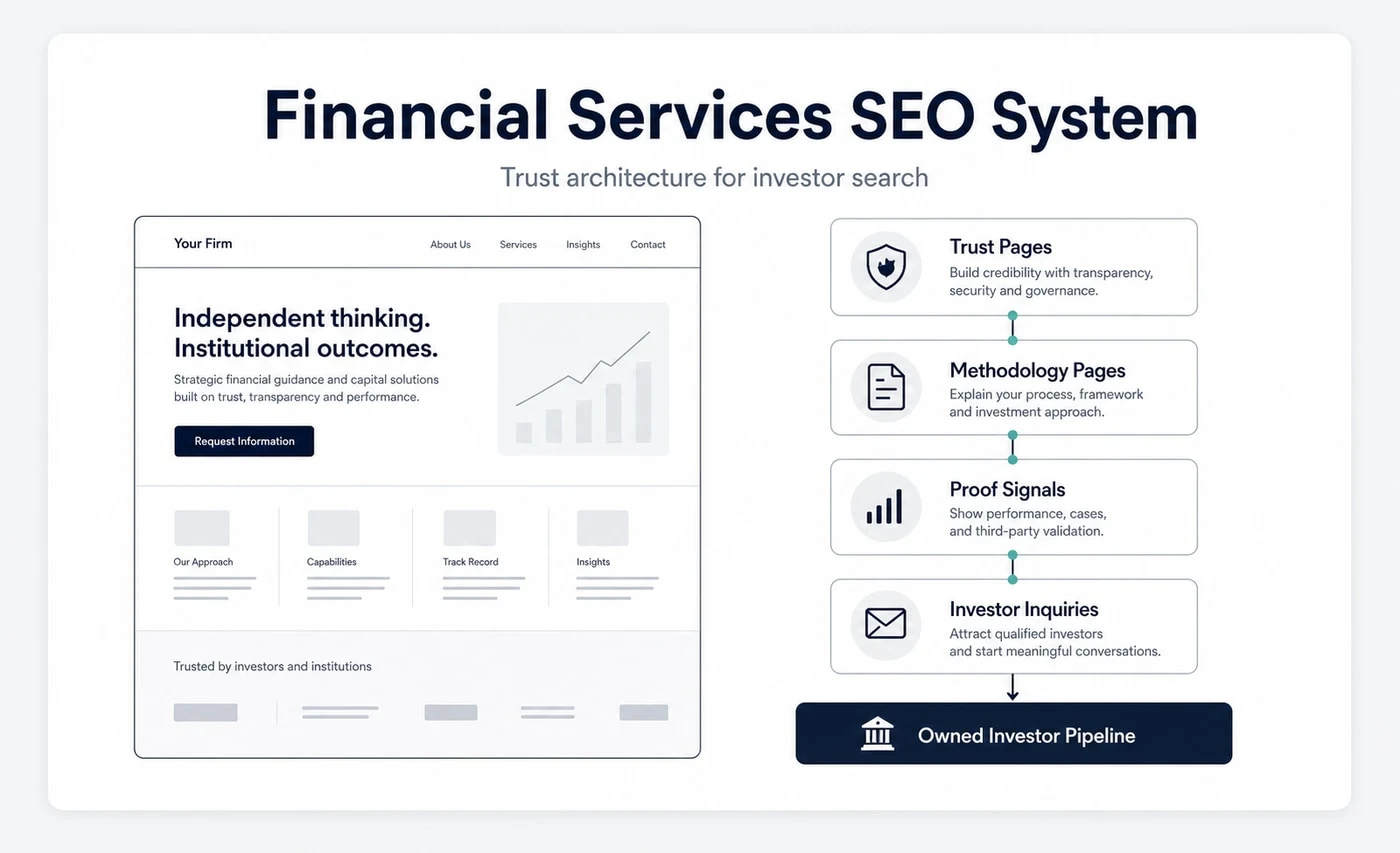
Groew Financial Services SEO service visual showing trust pages, methodology pages, proof signals and investor inquiries connected to an owned investor pipeline.

A trust-first SEO system built around investor diligence, methodology clarity, proof signals, and owned inquiry flow.

Most Agencies Do Not Understand the Buyer or the Rules

Generic SEO agencies treat financial services like any other B2B category. They optimize for clicks and keyword rankings. But financial services SEO operates under two constraints that collapse that approach immediately: Google classifies financial pages as YMYL and applies its strictest E-E-A-T scrutiny, and SEC and FINRA advertising guidelines restrict the performance claims and testimonials that most SEO relies on for conversion. The result is that most financial services websites have either thin pages that do not rank, or compliant pages that do not convert. Building infrastructure that satisfies both standards simultaneously is what this work actually requires.

The Trust Architecture We Build for Financial Services Firms

This is not a content calendar or a keyword report. We install organic search infrastructure that generates investor inquiries the way a well-run investor relations program generates capital: consistently, without depending on paid placements, and compounding over time.

01

Investor-Facing Commercial Pages Built to Convert Without Violating Compliance

Most financial services websites are information repositories. The homepage explains what the firm does. Strategy pages describe the approach. Team pages list credentials. None of it is structured to move an investor from awareness to inquiry. We rebuild investor-facing pages as trust conversion systems: proof surfaced prominently, methodology explained clearly, regulatory credentials visible, and a low-friction inquiry path on every commercial page.

02

Compliance-Aware SEO Architecture That Satisfies YMYL Standards

Financial pages face Google's highest trust bar. YMYL classification means thin pages, missing author credentials, and absent methodology documentation all result in suppressed rankings regardless of backlink count. Simultaneously, SEC and FINRA advertising guidelines restrict the type of social proof that generic SEO relies on. We build the technical and content foundation that satisfies both Google's quality threshold and regulatory requirements without conflict.

03

Named by AI Systems When Investors Research Strategies and Firms

Investors and allocators increasingly use AI assistants during early-stage research. When an investor asks Perplexity which firms manage a specific strategy, or which RIAs specialize in a particular asset class, the AI cites pages with entity-dense, structured content. Generic "we offer comprehensive financial services" descriptions earn no citations. Specific, named methodology, regulatory status, and investment approach get cited. We build the content architecture that earns those citations.

Alokk's perspective
Alokk, Founder at Groew
Alokk Founder and Lead Growth Architect, Groew
Financial services is the clearest example I have seen of the gap between offline credibility and online infrastructure. This investment firm had real expertise, a verifiable track record, and the kind of reputation that closes deals in a room. The website reflected none of it. Pages were generic. Trust signals were buried. The inquiry path was unclear. When we fixed the commercial pages to surface the firm's actual credibility, conversions went from 1.15% to 4.00% without changing the traffic volume. That single improvement, applied to existing traffic, contributed to $17.5M in investor capital attributed to organic growth over the engagement. That is not an SEO result. That is what happens when you install a Revenue Infrastructure on an asset that already had the authority to earn it.

Financial Services SEO Questions

Commercial page rebuilds and trust signal installation typically produce measurable conversion improvement within 60 to 90 days. Ranking movement for competitive financial queries takes 4 to 9 months depending on domain authority and target keywords. For one US investment firm, fixing trust infrastructure on commercial pages improved the conversion rate from 1.15% to 4.00% before significant new traffic was added. Infrastructure-first returns faster than content-first for financial services.
Financial services SEO operates under SEC and FINRA advertising regulations that restrict testimonials, past performance claims, and promotional language. Google classifies financial pages as Your Money Your Life, applying its highest E-E-A-T scrutiny. Buyers are high-net-worth individuals, institutional allocators, and financial intermediaries with 6 to 18 month decision cycles. Generic SEO strategies fail all three constraints. Every content and technical decision must be compliance-aware and trust-first from the start.
Yes. When an investor asks an AI assistant which firms specialize in a specific strategy or asset class, the AI cites pages with entity-dense, structured content naming the strategy, the regulatory status, and the methodology. Firms with generic website copy do not appear. Groew builds FAQPage schema, named entity optimization, and AI-extractable content architecture so financial services firms earn citations across both Google and AI search platforms. Use the AI brand visibility checker to see where you stand today.
For registered investment advisors, SEC Rule 206 governs advertising under the Investment Advisers Act. The SEC Marketing Rule permits client testimonials under strict conditions including disclosure requirements and performance substantiation. FINRA Rule 2210 governs broker-dealer communications, requiring fair and balanced presentation. Past performance claims require standardized disclaimers. Every content decision Groew makes for financial services clients is built around these constraints from the start, not reviewed by compliance after the fact.
Trust without testimonials is built through demonstrated expertise, methodology transparency, and verifiable credentials. Named team members with quantified experience, published market commentary, regulatory registration details, methodology descriptions that explain the investment process, and third-party media mentions all build credibility without violating advertising rules. For one investment firm, consolidating these signals on commercial pages improved conversion rate from 1.15% to 4.00%. Learn more about organic search infrastructure built for trust-sensitive businesses.
In order of conversion impact: investor-facing strategy and service pages with methodology and credentials surfaced clearly, team pages that quantify expertise and regulatory status, market commentary that demonstrates active analysis capability, FAQ content addressing investor due diligence questions, and educational content that moves prospects from awareness to inquiry. Blog volume without commercial page strength produces traffic that does not convert. Commercial pages always come first.
Attribution for high-ticket, long-cycle financial services requires UTM tracking on all landing pages and CRM source notes on every inquiry. Each investor contact is traced back to the referrer. When organic sessions convert to inquiries that become capital commitments or new clients, the attribution is direct. Use the true CAC calculator to quantify what each organic inquiry is worth versus paid channel equivalents.
Groew's infrastructure sprint starts at $3,000 USD per month. Financial services engagements vary based on how many investor-facing pages need rebuilding, the compliance complexity of the content, and whether technical SEO or trust architecture is the primary bottleneck. The establishes scope before any commitment. The audit report is yours to keep regardless of what you decide next.
Ask three questions. Do they understand SEC and FINRA advertising rules, or will their content recommendations create compliance liability? Do they lead with commercial pages or content volume? Do they show investor inquiry growth, not just traffic growth? Traffic is vanity for financial services. Compliance-unaware agencies produce work your legal team will reject. Content-first agencies produce traffic that does not convert. The right agency fixes infrastructure before scaling visibility.
Infrastructure-first SEO is particularly well-suited to long decision cycles. A high-net-worth investor or institutional allocator researches firms for months before making contact. The commercial page that answers their due diligence questions today becomes the firm they remember when the allocation decision opens. For one US investment firm, this approach contributed to $17.5M in new investor capital attributed to organic growth over the engagement. Long cycles reward compounding assets more than any other acquisition approach.
From Groew's Search Authority Team

What We Find When We Audit Financial Services Websites, and What Gets Fixed First

The gap between a financial services firm's offline credibility and its online presence is the most consistent finding across every audit we run. The credentials exist. The track record exists. The methodology exists. None of it is structured in a way Google can evaluate or AI systems can cite. Here is what the audit reveals and what the fix looks like in practice.

What the Audit Reveals on Every Financial Services Website

Named professionals are buried in bios that are not connected to any service or asset class page. Methodology is described vaguely or not at all. Regulatory registration exists on a compliance page that has no internal links and no authority transfer. Case results, where they can be disclosed, are not presented as structured evidence. The investor-facing pages that buyers actually search for do not exist: strategy pages, asset class pages, risk-adjusted return pages. The site was built for existing clients, not for organic discovery. When we restructure a financial services site, the first step is always mapping investor search queries to missing commercial pages, then surfacing the credentials and methodology that are already present but hidden. Story 10 saw $17.5M in new investor capital attributed to organic within 18 months of this restructure.

Read the complete guide

How to Build Trust Online Without Testimonials or Past Performance Claims

SEC Rule 206(4)-1 and the 2022 Marketing Rule set strict conditions on investment advisor testimonials, including disclosure requirements that most websites do not implement correctly. Rather than risk compliance violations, the more effective approach is to build trust through the five elements that regulatory guidelines permit without restriction: named professional credentials (CFA, CPA, JD, regulatory registrations), methodology transparency that explains the investment process without guaranteeing results, market commentary that demonstrates active analysis and expertise, third-party media mentions and publication bylines, and regulatory disclosure documents that position compliance as a signal of legitimacy rather than a legal requirement. For one investment firm, consolidating these signals on the main commercial pages improved conversion rate from 1.15% to 4.00% over the engagement period.

The Three Investor Buyer Roles and How Each Searches Differently

High-net-worth individuals searching for wealth management or investment advisory firms use queries that combine strategy type with credibility signals: "private equity real estate fund manager track record," "registered investment advisor alternative assets," "family office fee-only financial planner." They are verifying credibility and fit. Institutional allocators and family offices searching for fund managers or sub-advisors use more technical queries: "mid-market buyout fund manager SEC registered," "long/short equity hedge fund GIPS compliant." They are conducting formal due diligence. Financial intermediaries searching for products to distribute or recommend use distribution-specific language: "closed-end fund distribution terms," "interval fund minimum investment." A single generic page cannot serve all three. Industry-specific commercial pages built around these distinct search patterns are the foundation of financial services organic search.

Compliance-Aware Schema Markup for Financial Organizations

Structured data for financial services firms serves two purposes simultaneously: it helps search engines understand the entity and its credentials, and it creates machine-readable signals that AI systems use when compiling citations. The most useful schema types for financial services are Organization with legalName and regulatory identifiers, Person schema for named professionals with jobTitle and credential attributes, and Service schema with explicit serviceType descriptions. Importantly, none of these require testimonials or past performance claims. The SEC EDGAR CIK number, FINRA BrokerCheck registration number, and state registration details can all be encoded in schema without triggering advertising regulations, and they significantly improve entity recognition for both Google and AI platforms.

How AI Research Tools Change Investor Discovery

When an investor or allocator uses ChatGPT, Perplexity, or Gemini to research fund managers or investment strategies, the AI draws citations from pages with the highest entity density and structural clarity. A page that states "we invest in real estate debt strategies using a senior secured first-lien approach targeting 8 to 12 percent net returns with quarterly liquidity" gives the AI multiple named entities to extract and cite: the strategy type, the instrument type, the return target, the liquidity structure. A page that states "we offer comprehensive investment solutions across multiple strategies" gives the AI nothing to work with. Financial services firms that win AI citations are those whose commercial pages read like well-structured investment memoranda, not marketing brochures. Entity density and structural specificity matter more than length or publishing frequency.

Why the Revenue Infrastructure Model Applies Directly to Financial Services

Every investor inquiry generated by organic search is a lead the firm owns permanently. It does not disappear when a paid placement expires. It does not reset when a referral relationship goes cold. The commercial page that ranks for an investor due diligence query will continue generating inquiries for years if it is built correctly. This is the Revenue Infrastructure model applied to financial services: build the trust architecture once, maintain the content currency, and it compounds. The investment firm that understood this shifted from renting visibility through expensive placements and referral fees to owning its investor inquiry pipeline through organic authority. $17.5M in attributed capital later, the infrastructure is still running.

Find Out What Your Financial Services Site Is Missing

A 30 minute call. No pitch deck. We audit your investor-facing pages, trust signal placement, and compliance architecture and tell you exactly what to fix first.

Best fit for registered investment advisors, wealth management firms, alternative investment managers, and private equity firms with strong offline credibility that is not converting to organic investor inquiries. Groew does not work with unregistered investment promoters, cryptocurrency projects, or companies whose content would not pass SEC or FINRA advertising review.

ESC