Architecting Authority

AI Answers

AI Search Visibility For B2B Brands Buyers Ask About.

Buyers now ask ChatGPT, Perplexity, Gemini and Google AI before they visit a website. Groew builds the entity signals, answer ready pages, proof paths and tracking system that help AI tools understand when to mention your brand.

AI Search Visibility Prompts Entities Answers Sources

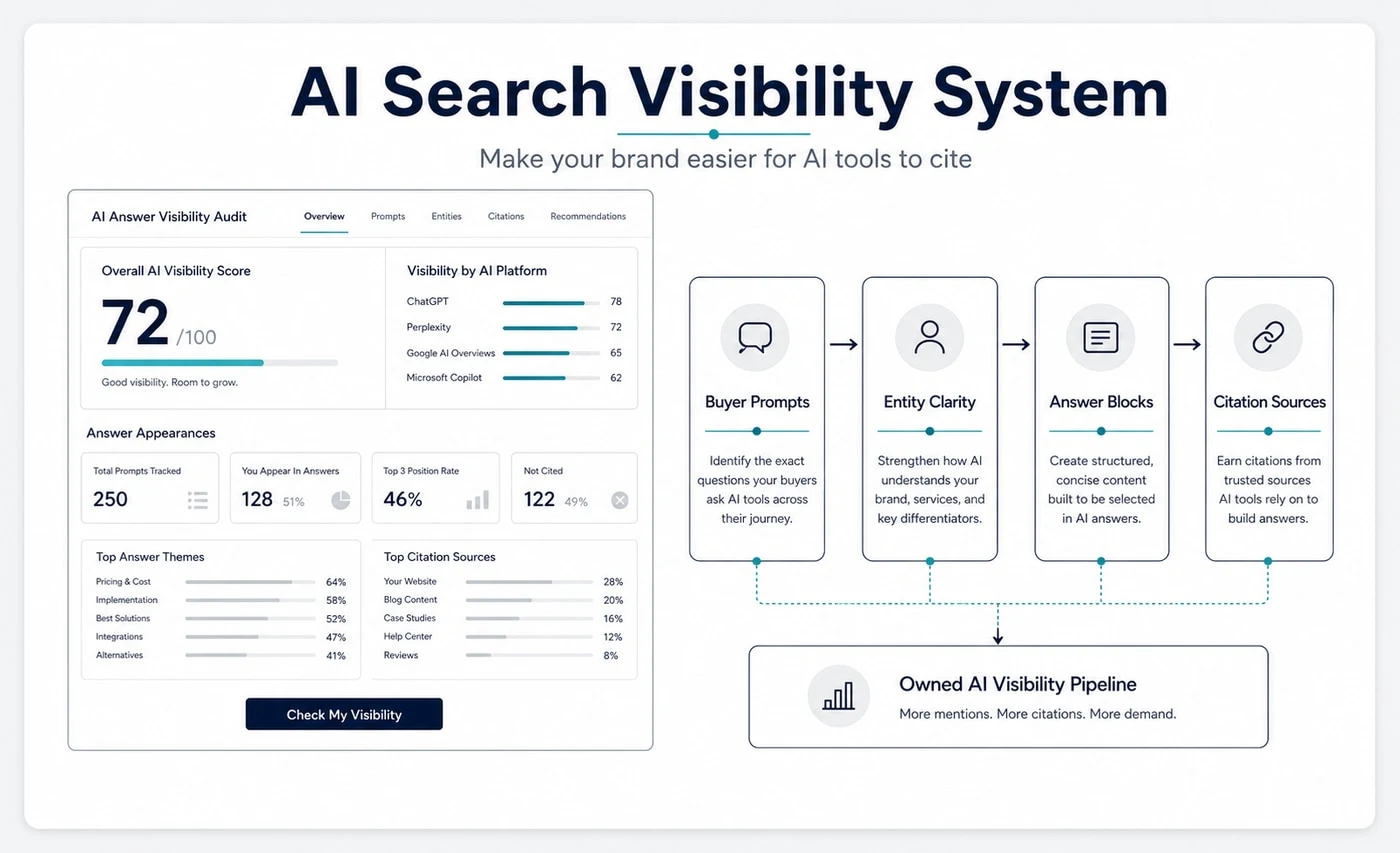
AI visibility is not a prompt trick. It is a source system. Buyer questions, clear entities, answer blocks and proof pages must connect.

Fast Answer

AI Search Visibility is whether AI systems mention and cite your brand.

AI Search Visibility shows whether ChatGPT, Perplexity, Gemini and Google AI understand your company well enough to mention it when buyers ask relevant questions. It depends on normal SEO foundations, entity clarity, direct answers, proof, structured data and source pages that AI systems can crawl and cite.

What We Audit

The signals that decide whether AI tools can trust your brand.

We test what AI tools say today, then work backward into the search, content, entity and proof signals that make your brand easier to understand and cite.

Buyer Prompt Map

We map the questions buyers ask AI tools before they search your site, compare vendors or book a call.

  • problem prompts
  • comparison prompts
  • vendor prompts

Brand Mention Audit

We test whether ChatGPT, Perplexity, Gemini and Google AI mention your brand, competitors or nobody useful.

  • brand mentions
  • competitor mentions
  • missing topics

Entity Clarity Review

We check whether your company, founder, services, proof and category are clear enough for AI systems to understand.

  • brand entity
  • service entity
  • author signals

Answer Block System

We structure pages with direct answers that AI systems can extract without losing context or commercial meaning.

  • fast answers
  • definition blocks
  • comparison blocks

Schema And Crawl Check

We review structured data, canonical rules, robots access and indexing signals that affect AI source eligibility.

  • schema markup
  • canonical rules
  • crawler access

Citation Source Gap

We identify which pages, articles, case stories and external mentions are missing from your citation path.

  • source gaps
  • proof gaps
  • trust gaps

AI Content Refresh

We update existing pages so the answer appears earlier, proof is easier to verify and the page becomes clearer to cite.

  • answer order
  • proof placement
  • entity density

Visibility Reporting

We track AI mentions, citations, source inclusion, competitor share and referral traffic from AI platforms.

  • citation rate
  • source share
  • AI referrals
Founder Risk

AI tools can compare you before the buyer reaches your site.

A founder may still see Google rankings and think the brand is visible. The buyer journey has changed. A buyer can ask an AI tool who to consider, what risks to check and which vendor fits their situation before opening any search result.

The risk is not only losing traffic. The larger risk is being absent when the buyer forms their shortlist. If competitors appear in AI answers and you do not, you are being filtered out earlier than your analytics can show.

What You Get

An AI visibility system connected to SEO.

  • Prompt testing We test the questions buyers actually ask before they contact a vendor.
  • Entity structure We make your company, services, proof and category easier for AI systems to connect.
  • Citation paths We connect answers to proof pages, tools, insights, case stories and structured service pages.
Deliverables

What Groew includes in AI Search Visibility.

The output shows what AI systems currently understand, which competitors appear where you do not and what needs to be rebuilt across search, content and proof.

AI visibility baseline across ChatGPT, Perplexity, Gemini and Google AI results
Buyer prompt map built from problem, comparison and vendor research queries
Competitor citation gap analysis showing who appears where you do not
Entity clarity audit for brand, founder, service, proof and category signals
Answer block plan for service pages, insight pages and tool pages
Schema and crawl access review for AI source eligibility
Citation ready content updates using proof, data and first hand observations
Internal link map that connects AI answers to case stories, tools and services
Monthly AI visibility checks for mentions, citations and source inclusion
Reporting view for AI referral traffic, assisted enquiries and query coverage
Platform Reality

Each AI surface reads the web differently, but the foundation is shared.

Competitors often sell AI visibility like a separate channel. In practice, the same search foundations still matter: crawlability, helpful content, entity clarity, proof and authority.

Google AI

Pages still need normal search eligibility. Google needs to crawl, index, understand and trust the page before AI features can use it.

ChatGPT

ChatGPT needs clear entities, strong answer structure, proof and source pages that explain why your brand fits the buyer question.

Perplexity

Perplexity shows citations more visibly. Pages need clear answers, accessible content and source level detail that can be cited directly.

Gemini

Gemini is connected to the wider Google ecosystem. Strong technical SEO, structured data and helpful content still matter.

Reality Check

What is real AI visibility work and what is just hype.

Real Testing buyer prompts, measuring citations, improving answer structure and strengthening source pages.
Assumption Guaranteeing ChatGPT citations or claiming AI search can be hacked with prompts.
Real Building entity clarity, schema, helpful content, proof, internal links and crawlable pages.
Assumption Publishing generic AI written pages and expecting them to beat trusted sources.
Research Signal

AI visibility follows structure, authority and source clarity.

Groew research across B2B sites found that AI visibility does not move independently from search quality. When Google rankings dropped across 11 B2B websites, ChatGPT citations fell by an average of 27.8%. That means AI visibility is not a replacement for SEO. It is another layer on top of the same owned search infrastructure.

We also found that answer placement matters. In our AI citation analysis, 44% of citations came from the first 30 percent of the content. The page must answer early, prove clearly and connect the claim to trusted source material.

Read My AI Citation Research →
27.8% average ChatGPT citation drop when Google rankings fell across 11 B2B sites
44% of citations coming from the first 30 percent of content in Groew research
14.2% Perplexity visitor conversion rate reported in Groew AI visibility research
What Gets Fixed

Most invisible brands are unclear, not unknown.

AI tools often skip a brand because the web does not explain the brand clearly enough. The site may rank for some keywords, but the service page does not define who it serves, what it fixes, what proof exists and why the buyer should trust it.

  • Service clarity State exactly what the company does, who it serves and when it is not a fit.
  • Proof clarity Connect claims to case stories, numbers, screenshots and operating details.
  • Source clarity Make each page easy to cite with direct answers, structured headings and internal proof links.
How We Measure

AI visibility needs a scorecard, not a one time screenshot.

One AI answer can change by prompt, account, location and model. The useful measurement is trend direction across a fixed prompt set. We track brand mentions, competitor mentions, cited pages, missing topics, AI referral traffic and assisted enquiries.

This gives founders a practical view: where AI tools already trust the brand, where competitors are being cited and which pages need stronger source signals.

Alokk's perspective
Alokk, Founder at Groew
Alokk Founder and Lead Growth Architect, Groew
When I test B2B brands in AI answers, the first gap is usually not technology. It is clarity. The page does not say who the company serves, what problem it owns, what proof supports the claim and where a buyer should go next. In our 11 site citation research, ChatGPT citations dropped by 27.8% when Google rankings dropped. That is why I treat AI visibility as Revenue Infrastructure, not a separate AI trick.
Questions

Common questions about AI Search Visibility.

AI Search Visibility is whether AI answer systems such as ChatGPT, Perplexity, Gemini and Google AI understand, mention and cite your brand when buyers ask relevant questions.
It is a new layer on top of SEO, not a replacement. AI systems still need crawlable pages, helpful content, entity clarity, structured data, proof and topical authority.
No responsible team can guarantee AI citations. Groew improves the signals that make citation more likely: clear entities, answer blocks, proof, schema, source pages and authority.
Groew measures brand mentions, cited URLs, competitor visibility, query coverage, source inclusion, AI referral traffic and assisted enquiries from AI platforms.
Start with the same foundation that supports search: crawl access, indexable pages, clear service pages, strong topic clusters, direct answers, proof and structured data.
From Groew's Search Authority Team

How to build AI Search Visibility without weakening SEO

AI visibility works when the page is useful to search engines, AI systems and real buyers at the same time. The goal is not to write for machines. The goal is to make your expertise easier to understand, verify and cite.

Start with the questions buyers ask AI tools

AI visibility starts with buyer questions, not model names. A B2B buyer may ask which vendors to compare, what risks matter, how much a service should cost, what proof to request and what mistakes to avoid. These questions are often closer to the sales call than traditional informational keywords. If your pages do not answer them clearly, AI tools have little reason to mention your brand when the buyer asks.

The first step is building a fixed prompt set. This gives you a stable baseline. Test the same problem, comparison and vendor prompts across the major AI surfaces every month. Record which brands appear, which URLs are cited and which topics are missing from your own site.

Read the complete guide

Keep normal SEO as the foundation

Google has been clear that AI features still depend on normal search fundamentals. Pages need to be crawlable, indexable, helpful and eligible to appear in search results. The same foundation matters outside Google as well. If AI systems cannot access the page, cannot understand the main entity or cannot verify the claim, the page becomes a weak source.

This is why AI visibility should not be treated as a separate campaign. Technical SEO, content structure, schema, internal links and proof pages all support the same goal. They help search engines understand the page and they help AI systems decide whether the page is a reliable source for an answer.

Make the entity impossible to misunderstand

AI systems need to understand what the company is, what it sells, who it serves and why it should be trusted. Many B2B websites make this harder than it needs to be. They use vague category language, hide founder expertise, split proof across unrelated pages and avoid saying who the service is not for. That ambiguity weakens citation confidence.

A strong AI visibility page names the company, service, audience, use case, proof and next step in plain language. It also links to supporting material: case stories, tools, insight pages, author pages and structured service pages. These connections create a stronger entity graph around the brand.

Put the answer before the explanation

AI systems need extractable answers. Human buyers need them too. The page should answer the main question early, then add evidence, process and context. A page that hides the answer after a long introduction is harder to cite and harder to use. In Groew citation analysis, a large share of citations came from the first part of the page, where the direct answer was easiest to extract.

This does not mean every page should become a list of short snippets. The page still needs depth. The best structure is direct answer first, proof second and deeper context third. That structure works for Google, AI systems and a founder trying to make a decision quickly.

Measure trend direction, not one answer

AI answers vary. A single screenshot is not a measurement system. The useful signal is whether the same prompt set starts showing the brand more often over time, whether the cited URLs become more relevant and whether competitor dominance shrinks across commercial prompts. This requires a monthly scorecard, not a one time check.

The scorecard should include brand mentions, cited URLs, competitor mentions, missing prompt categories, AI referral traffic and assisted enquiries. If the brand is mentioned but no traffic arrives, the answer may not include a strong source path. If competitors are cited but you are not, the gap may be content depth, entity clarity or third party authority.

Build AI visibility as Revenue Infrastructure

The strongest AI visibility systems are owned assets. The company owns the service pages, proof pages, tools, insights, schema and internal links that make the brand easier to cite. That is very different from renting attention through ads or buying a platform score with no implementation path.

Groew builds AI Search Visibility inside B2B SEO Infrastructure. The goal is not to chase every new model. The goal is to build the clear, useful and verifiable source system that Google, ChatGPT, Perplexity, Gemini and real buyers can all understand.

Find out whether AI tools mention your brand before buyers compare vendors.

Groew will audit your current AI visibility, map the buyer prompts that matter and show which pages need stronger entity, answer and proof signals.

Check My AI Visibility
ESC