
Architecting Authority

Map Rank 19 to 2 in One Month. Organic Share of Lease Volume From 8% to 30%.

Most commercial real estate websites are built for listing portals, not organic buyers. We fix that. Tenants, investors, and site selectors research firms and markets on Google before they open CoStar. That research stage is where we build your presence.
See how the infrastructure sprint works
$17.5M+Investor Capital
8xConversion Growth
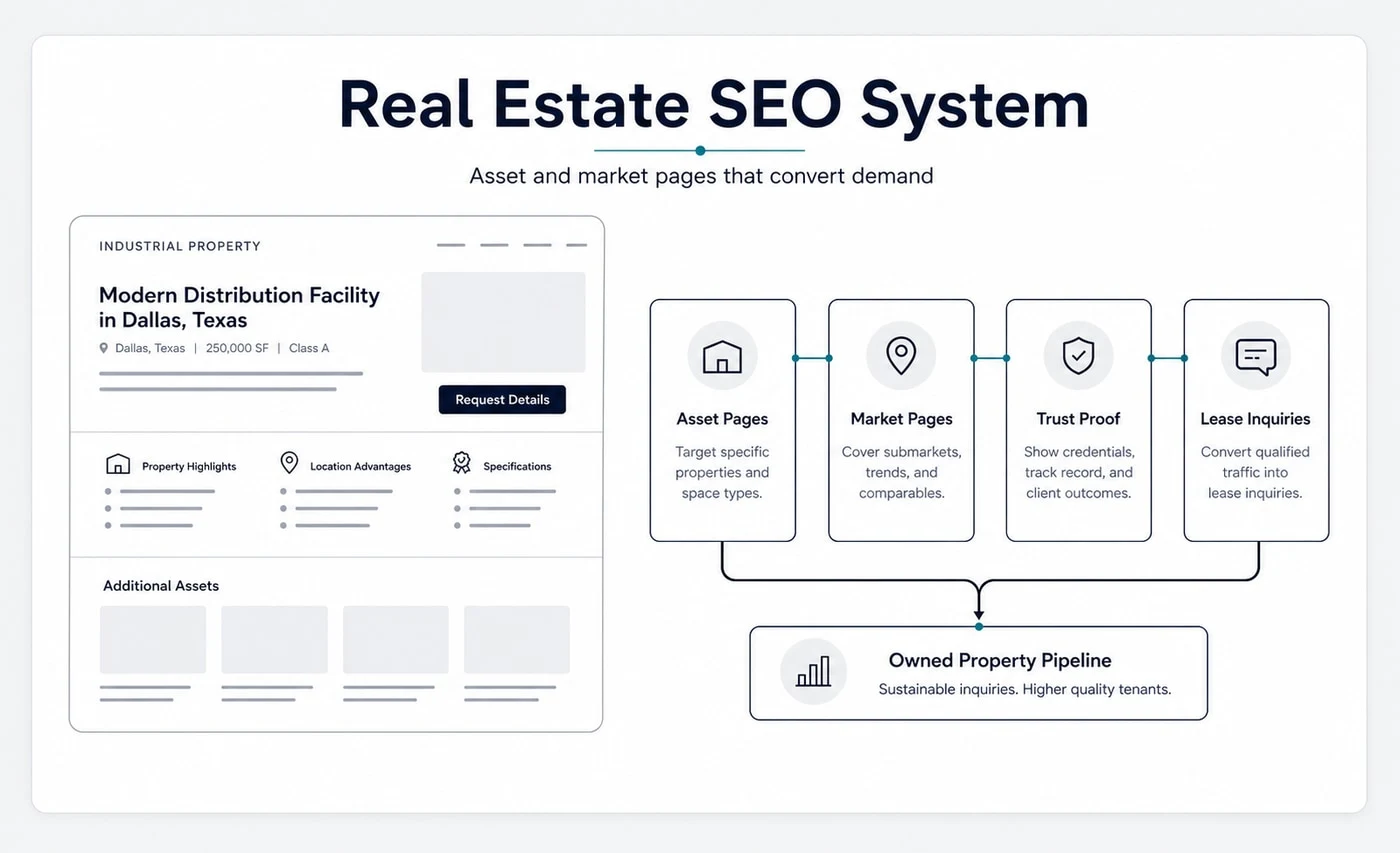
Groew Real Estate SEO service visual showing asset pages, market pages, trust proof and lease inquiries connected to an owned property pipeline.

A real estate search system built around asset pages, market demand, trust proof, and lease inquiry flow.

Why Commercial Real Estate Firms Get Bypassed Before Any Buyer Makes Contact

Tenants, investors, and site selectors research firms and markets on Google before they ever open CoStar, LoopNet, or Crexi. A tenant rep looking for industrial space in a specific market searches by geography, asset class, and requirement before picking up the phone. A capital allocator evaluating a real estate firm searches by strategy, methodology, and track record before requesting an intro. That research stage is where shortlists are built. The firms with pages that answer those specific queries get on the list. The firms with only a portfolio grid and a contact form do not appear until after the decision is already made.

The Search Infrastructure We Build for CRE Operators

This is not a CoStar competitor strategy or a content marketing plan. We install organic search infrastructure that generates tenant inquiries and investor interest the way a mature portfolio generates income: consistently, without depending on per-listing fees, and compounding as market authority grows.

01

Asset-Class and Market Pages Built for Buyer Research Queries

The first thing we build is what should have existed from day one: a dedicated page for every asset class in every market the firm operates. Not a listings feed. Not a portfolio grid. A page that answers the specific questions a tenant rep, capital allocator, or site selector types before they contact anyone. Industrial space in Chicago with dock-high loading. Cold storage NNN lease midwest. Cap rate methodology for value-add industrial assets. Each of these queries needs its own page, built around the exact terminology that buyer uses.

02

Multi-Market Architecture That Makes Every Office and Hub Visible

A CRE firm operating in 6 markets has 6 local search opportunities. Each one is separate. A single "markets served" page with a list of cities earns no authority for any of them. We build an individual page for every regional office, every market hub, and every city where the portfolio operates. Each page earns its own local ranking signals. We coordinate Google Business Profile across all locations so each office surfaces when buyers search within that market.

03

Appearing in ChatGPT When Capital Allocators Research Firms and Markets

Capital allocators and institutional investors increasingly use AI assistants during early-stage firm research. When an allocator asks Perplexity which firms specialize in midwest industrial cap rates, or which REITs have a track record in cold storage NNN leases, the AI cites pages with entity-dense, structured content naming the strategy, the regulatory status, and the methodology. Generic firm descriptions produce no citations. Named cap rates, named deal types, named zoning classifications, and compliance credentials do. We build the content architecture that earns those citations.

Alokk's perspective
Alokk, Founder at Groew
Alokk Founder and Lead Growth Architect, Groew
When we audit commercial real estate websites, the gap is structural and it is always the same: the research stage is completely unowned. CoStar gets the buyer who already knows what they want. The buyer who is still deciding which market, which firm, which landlord to work with is on Google. When we installed market-specific infrastructure for a multi-market US warehouse company, map rank moved from 19 to 2 within one month and organic share of lease volume went from 8% to 30%. The properties did not change. The markets did not change. The only thing that changed was that the firm now owned the pages where the research happened. That is the Digital Landlord model applied to property itself: building assets that compound instead of renting attention from platforms that charge per view.

Commercial Real Estate SEO Questions

Asset-class and market page infrastructure typically produces measurable inquiry improvement within 60 to 90 days. Ranking movement for competitive CRE market queries takes 4 to 8 months. For one multi-market US warehouse leasing company, local search improvements moved map rank from 19 to 2 within one month, and organic share of lease volume grew from 8% to 30% of total volume in the same period.
CRE buyers research before they open portals. A tenant rep evaluates landlords by market and asset class on Google. A capital allocator researches investment firms by strategy, cap rate methodology, and regulatory credentials. A site selector qualifies a city by infrastructure and zoning. Generic SEO targets broad category terms portals already own. CRE SEO builds pages for the research stage that CoStar and LoopNet do not compete for.
CoStar owns active listing searches where a buyer knows exactly what they want and is comparing options. Organic search owns the stage before that. When a capital allocator is researching which firm has the strongest track record in a market, when a tenant rep is evaluating which landlord to work with, those conversations happen on Google. CoStar is not in them. Groew builds the pages that are. CoStar gets the browsers. Organic search gets the buyers.
You do not compete with CoStar on active listing queries. You own the queries buyers use before and after portals: market intelligence searches, firm reputation searches, investment thesis searches, and asset-class expertise searches. A well-built industrial asset-class page for a specific market outranks CoStar for firm-level research queries because CoStar does not build firm expertise pages. That research stage is available to own.
Both simultaneously. National SEO targets investors and institutional allocators researching firm strategy and track record across all markets. Local SEO targets tenants and site selectors searching for space and partners in specific cities. Groew builds asset-class pages that rank nationally for firm expertise, and individual market pages with LocalBusiness schema that rank locally for each city where the portfolio operates.
Yes. When an allocator asks ChatGPT which firms specialize in industrial cap rates in the midwest, or which REITs have a track record in cold storage NNN leases, the AI cites pages with structured content naming the strategy, market focus, regulatory status, and methodology. Generic firm descriptions earn no citations. Groew builds FAQPage schema and named entity optimization so your firm is cited in investor research queries. Use the AI brand visibility checker to test whether your firm appears in AI recommendations today.
Tenant-facing pages target asset-class and market queries: industrial space in specific cities, ceiling heights and dock configurations, zoning classifications, and lease terms. Investor-facing pages target strategy and track record queries: cap rate methodology, deal history, asset class specialization, and regulatory credentials. Each set of pages targets a distinct buyer type with distinct intent. Internal link architecture flows authority between them without one set undermining the other.
Groew's infrastructure sprint starts at $3,000 USD per month. CRE engagements vary based on the number of asset-class and market pages that need building, the portfolio size, and whether investor-facing trust architecture or tenant-facing local search is the primary bottleneck. There is no open-ended retainer. The best first step is a where we map the asset-class and market gaps before any investment is discussed.
Ask three questions. Do they understand the CoStar dynamic and the research-stage queries portals do not own? An agency that pitches competing with CoStar on listing terms has misunderstood the problem. Do they separate tenant SEO from investor SEO? One page strategy for both buyer types produces nothing. Can they show inquiry growth from organic, not just ranking reports? Rankings without inquiries are not a CRE result.
Infrastructure-first SEO is well-suited to long decision cycles. A tenant rep evaluating a landlord for a five-year lease researches months before any conversation. A capital allocator may take 6 to 18 months from first online discovery to capital commitment. For one multi-market warehouse company, installing local search infrastructure grew organic lease volume from 8% to 30% of total volume. Long cycles reward compounding assets more than any other acquisition approach.
From Groew's Search Authority Team

Commercial Real Estate SEO: How to Rank for the Searches Buyers Do Before Opening CoStar

Most CRE firms invest in CoStar and LoopNet and assume digital presence is covered. It is not. Portals own one stage of the buyer journey. The research stage that precedes portals is completely available to own. The firms that built their organic infrastructure are now generating tenant inquiries and investor interest from buyers who arrive having already decided they want to speak to this firm specifically.

What We Find When We Audit Commercial Real Estate Websites

The audit findings are consistent across portfolio size and market. One generic "properties" or "services" page trying to rank for industrial, office, flex, and NNN simultaneously. It ranks for none of them. A single "markets" page listing 8 cities with no individual market content. No investor-facing pages naming cap rate methodology, deal history, or regulatory credentials. No tenant criteria pages answering ceiling height, loading dock, power, and zoning questions. The result is a website that looks like a brochure and functions like one: it does not generate inbound inquiries from buyers who do not already know the firm. Everything CoStar sends converts or doesn't. Nothing organic arrives at all.

Read the complete guide

What We Build First: Asset-Class Pages for the Pre-Portal Research Stage

The first pages we build are the ones that should have existed already. Each asset class gets its own page. Each page targets the specific search language buyers use for that asset class in that market. Industrial warehouse space is not searched for the same way as flex office or cold storage NNN. A page titled "Industrial Warehouse Space Chicago" with ceiling height specifications, dock-high loading bay counts, power availability, and proximity to major highway corridors ranks for the queries engineers, operations managers, and tenant reps use when qualifying space before any site visit. The same page with cap rate methodology context and deal history information serves investor research queries. When we installed this architecture for a multi-market US warehouse company, map rank moved from 19 to 2 in one month and organic share of lease volume grew from 8% to 30%.

How We Make Every Market Visible in Its Own Local Search Results

A CRE firm with offices in Chicago, Dallas, Atlanta, Denver, and Phoenix has five separate local search opportunities. When a shipper, tenant rep, or site selector searches for industrial space in Atlanta, Google's local algorithm looks for a page with Atlanta-specific signals, not a national "markets served" page that mentions Atlanta in a list. We build an individual page for each market with LocalBusiness schema, specific operating details for that location, portfolio context for that city, and Google Business Profile signals coordinated to that address. Each location earns its own local ranking authority. The Chicago office ranks in Chicago searches. The Atlanta office ranks in Atlanta searches. They compound each other rather than competing.

What Happens When Capital Allocators Research Your Firm in ChatGPT

When an institutional allocator asks ChatGPT which firms specialize in value-add industrial assets in the midwest with cap rates between 5.5% and 7%, the AI does not query CoStar. It cites the pages in its retrieval index that most directly answer the question with named, structured content. Pages that explicitly name the cap rate methodology, the asset class focus, the specific markets, and the regulatory status of the firm are cited. Generic "we offer comprehensive real estate services" copy is not cited. The content architecture that earns AI citations and the content architecture that ranks in Google for investor research queries are identical. We build this architecture once and it serves both channels simultaneously.

Portal Dependency vs Revenue Infrastructure: What Compounds and What Doesn't

Every tenant that arrives through CoStar or LoopNet has a platform cost attached. Every investor inquiry that arrives through a conference or a referral network is a rented relationship. Stop the subscription and the CoStar volume stops. Step away from the network and the referrals slow. Revenue Infrastructure builds something different: asset-class pages, market pages, and investor content that rank permanently and generate inquiries without per-transaction cost. The cost per inquiry falls with every quarter as organic authority compounds. A CRE firm that built its organic infrastructure three years ago now generates tenant and investor inquiries at a fraction of the cost of its portal-dependent competitors. The firms still renting all of their leads are competing on an increasingly expensive cost structure. The firms that built their infrastructure are compounding on a permanent asset.

Find Out What Your CRE Site Is Missing

A 30 minute call. No pitch deck. We audit your asset-class page coverage, market visibility gaps, and investor trust architecture before any investment is discussed.

Best fit for commercial property owners, warehouse landlords, industrial REITs, tenant rep brokers, and real estate investment firms with owned properties across multiple markets. Groew does not work with residential real estate agents, general listing platforms, or proptech SaaS companies.

ESC